 Prayer & Intercession
I should sin against the LORD by ceasing to pray (1 Samuel 12:23)
- Why Do We Pray?
- The Season of Prayer
- The Prayer of the Anointed
- The Struggle to Pray
- Wrong, Weak or Ineffective Prayer
- Prayer of Repentance
- Pray for Revival
- Prayer of the Reformers
- E.M.Bounds, Power Through Prayer
- John Calvin and Martin Luther on prayer
- Oswald Chambers on Prayer
- Charles Finney, How to Experience Revival
- P. T. Forsyth, The Soul of Prayer
- Harry Emerson Fosdick, The Meaning of Prayer
- Wm. Gurnall, The Christian in Complete Armour
- Kent Henrey Streaming in Heaven's Flow
- Rees Howells on Intercession
- Bill and Beni Johnson on Prayer
- R.T. Kendall, Did You Think to Pray?
- Andrew Murray on Prayer
- Watchman Nee on The Prayer Ministry of the Church
- J.I. Packer on Prayer & Knowing God
- Jessie Penn-Lewis, Prayer & Evangelism
- Derek Prince, Secrets of a Prayer Warrior
- Leonard Ravenhill on prayer
- Brian & Candice Simmons, Throne Room Prayer
- Charles Hadden Spurgeon, The Golden Key of Prayer
- A. W. Tozer, On God's Warriors
- John Wesley, How to Pray
- David Wilkerson, God's Plan
- links to other useful prayer sites

Prayer is an ongoing interest of mine, ever since I led intercessory prayer on Sunday mornings for a decade. Expect me to add interesting quotes as I find them. Some are from some of the widely recognized works on prayer (E.M. Bound, Andrew Murray) and others are from lessor know works, two of which I would highly recommend: P.T. Forsyth on The Soul of Prayer, Harry Emerson Fosdick, on The Meaning of Prayer, and Jesse Penn-Lewis's short book Prayer and Evangelism. One new book which I highly recommend is by the late Derek Prince: Secrets of a Prayer Warrior. I am also a fan of the writings of Francis Frangipane whose book Prevailing Prayer I completed recently. It is an excerpt of his book now titled The Power of Covenant Prayer, which I would expect is an excellent book, and which I intend to acquire. By far, the best book I have read on the Lord's Prayer is by Albert Mohler: The Prayer That Turns the World Upside Down.
I suppose that I should begin with, What is prayer? I rather like the excerpt of John Climacus, one of the “desert fathers” quoted in John Michael Talbot's Desert Dangers and Delights: “Prayer is by nature a dialogue and a union of man with God. Its effect is to hold the world together. It achieves a reconciliation with God… The beginning of prayer is the expulsion of distractions from the very start by a single plot; the middle stage is the concentration on what is being said or thought; it's conclusion is rapture in the Lord… When a man has found the Lord, he no longer has to use words when he is praying, for the Spirit Himself will intercede for him with groans that cannot be uttered (Romans 8:26)” (Talbot, 2020, 268-269).
Recent books of note: The Happy Intercessor by Beni Johnson, of Bethel Church in Redding, CA. Don Nordin's book The Audacity of Prayer is filled with testimonies of miracles accomplished by prayer. It's engaging and easy to read.
I recently completed the book Taking Hold of God, Reformed and Puritan Perspectives on Prayer published in 2011. This book distills the thoughts on prayer of the Reformers from Luther and Calvin up through Jonathan Edwards. This is definitely a must for any serious library. While it is not the breezy read of Beni Johnson's book, it is worth the effort. It will not only instill a deeper admiration for some of these great leaders, but also provide insight into just what made them so great. Don't we pray so that we can become as close to God as they were? The one drawback to this book is that it lacks practical examples of the effect of prayer, which is why I would combine it with some of the other contemporary books on prayer.
Also recently completed is The Jesus Fast, By Lou Engle with Dean Briggs. This book combines a vision for fasting and aggressive intercessory prayer. Promoted at the recent Azusa Now! rally. I really enjoyed this book and am stirred to action by it.
Why Do We Pray?
Psalm 141:2 May my prayer be counted as incense before You; The lifting up of my hands as the evening offering.
Revelations 5:7-8 And He came and took the book out of the right hand of Him who sat on the throne. When He had taken the book, the four living creatures and the twenty-four elders fell down before the Lamb, each one holding a harp and golden bowls full of incense, which are the prayers of the saints. (also: Rev. 8:4).
“Christ stands between us, and we can only get into touch with our neighbours through him. That is why intercession is the most promising way to reach our neighbours, and corporate prayer, offered in the name of Christ, the purest form of fellowship.” Dietrich Bonhoeffer,The Cost of Discipleship, 1995, pg. 98.
“To clasp the hands in prayer is the beginning of an uprising against the disorder of the world.” Karl Barth
“History belongs to the intercessor!” attributed to several...
Why? The answer is simple: so that the power of the Holy Spirit will be in you and in what you do. R.A. Torrey's testimony on D. L. Moody suggests that one of the foremost reason's why Moody was such a successful evangelist, was prayer. “Yes, D. L. Moody certainly was a wonderful preacher; taking it all in all, the most wonderful preacher I have ever heard, and it was a great privilege to hear him preach as he alone could preach; but out of a very intimate acquaintance with him I wish to testify that he was a far greater pray-er than he was a preacher.” There are even stronger voices: “The worst sin is prayerlessness. Overt sin, or crime, or the glaring inconsistencies which often surprise us in Christian people are the effect of this, or its punishment. We are left by God for lack of seeking Him.” (P.T. Forsyth, The Soul of Prayer).
“People who know their God are before anything else people who pray.” J.I. Packer, Knowing God, 1973(1993), pg. 28.
“For a Christian, prayer is the same as breathing is to the natural body. Prayer is absolutely the survival mechanism for Christians.” Don Nordin, The Audacity of Prayer, 2014. Page 1.
In this regard, I include here an extended quote from E.M. Bounds which R. Kent Hughes uses in his commentary on the Epistle to the Ephesians: “Some years ago the record of a wonderful work of grace in connection with one of the stations of the China Inland Mission attracted a good deal of attention. Both the number and spiritual character of the converts had been far greater than at other stations where the consecration of the missionaries had been just as great. This rich harvest of souls remained a mystery until Hudson Taylor, on a visit to England, discovered the secret. At the close of one of his addresses a gentleman came forward to make his acquaintance. In the conversation which followed, Mr. Taylor was surprised at the accurate knowledge the man possessed concerning this China Inland Mission station. ‘But how is it,’ Mr. Taylor asked, ‘that you are so conversant with the conditions of that work?’ ‘Oh!’ he replied, ‘the missionary there and I are old college mates; for years we have regularly corresponded; he has sent me names of enquirers and converts, and these I have daily taken to God in prayer.’ At last the secret was found—a praying man, praying definitely, praying daily.” (R. Kent Hughes, Ephesians, The Mystery of the Body of Christ. 1990. Page 254. Taken from E.M.Bounds, Purpose in Prayer.)
“The sins which man commits—those are not his great crime. Temptation is powerful and his strength is slight! The great crime of man is that he can turn (to God) at every moment, and does not do so.” (Hasidic saying by Rabbi Bunam, in Martin Buber, 1976. page 80).
The more common answer is that we pray when we need God. I would certainly not want to condemn that urge, God should be the one we seek in time of need. Senator and former presidential candidate John McCain is pragmatic in regards to his suffering in North Vietnamese prisons: “I was finding that prayer helped. It wasn't a question of asking for superhuman strength or for God to strike the North Vietnamese dead. It was asking for moral and physical courage, for guidance and wisdom to do the right thing. I asked for comfort when I was in pain, and sometimes I received relief. I was sustained in many times of trial.” (from John McCain’s first person account of his imprisonment and torture. published in U.S. News in May 1973, available online). But I would strongly caution that our prayer life should not be on the shelf waiting for a desperate need.
If we are hearts are engaged, there are always desperate needs that should not only motivate us to prayer, but should motivate us to find other ways to involve ourselves in solutions. A totally self-satisfied, self-involved heart is not a Christian heart. “When you stop caring, you start dying.” (John Mulinde, Africamp 2011).
“In all the 25 years of this ministry, every major breakthrough we have seen in the work has come through prayer. Through prayer, we let God be God, yielding ourselves as earthen vessels and becoming channels for His work. I am deeply convinced that the shortest route to getting things done is by prayer.” (K.P. Yohannan, Learning to Pray, 2004. Page 43).
Derek Prince puts it well: “The instrument that most people mean when they talk about ‘prayer’ is petition, asking for physical and material needs to be met. But remember: Praying is not just thinking of anything we want and asking for it. Praying is discovering God revealed purpose in Scripture, and then praying for the outworking of that purpose. Look again at 1 John 5:14-15: ‘Now this is the confidence that we have in Him, that if we ask anything according to His will, He hears us. And if we know that He hears us, whatever we ask, we know that we have the petitions that we ask of Him.’ ” (Derek Prince, 2009. Page 74).
Following up on Prince's comments, “Prayer is more about hearing than about verbalizing. As you seek to hear what the Lord desires and you do it, you will see your life transformed.” (K.P. Yohannan, Learning to Pray, 2004. Page 50). This is even more of a concern in group prayer settings where pent up desire to preach, new websites to share, catching up with friends and other distractions can close the prayer meeting to the most important visitor: “Unless we make sure we are listening to Him and following His lead, the Lord may be saying, ‘I waited for you to be quiet and open your heart to Me, but you wouldn’t. You were so busy following the program that you missed Me. You talked to each other, but you didn’t talk to Me; you didn’t even listen to Me. There was no time when I could share My concerns with you.’ ” (K.P. Yohannan, Learning to Pray, 2004. Page 51).
Oswald Chambers suggests that prayer "develops the life of God in us", nourishing the seed planted at rebirth so that it grows, flourishes and becomes fruitful. Clearly the heart of mercy develops and deepens within us as we intercede for others. I was accused of being overly harsh to a member of my community household. I took the matter to God in prayer. God told me that because I didn't have as much contact with that person, I did not pray for them, I was reacting to their externals but not to that person in depth. Those who I pray for I can touch in a special way, which nourishes not only them, but myself as well.
Much of modern theology is influenced by Kierkegaard's existentialism. Kierkegaard was reacting to the deadness of his contemporary Danish Lutheran Church, suggesting that thinking about God was failing to bring the church into relationship (existential) with God. Clearly prayer has to be the most significant factor in creating a relationship with the living God. His prayer: “God in heaven, I thank Thee that Thou hast not required it of man that he should comprehend Christianity… I thank Thee that Thou dost only require faith, and I pray Thee to increase it more and more.” (Soren Kierkegaard. The Sickness Unto Death. pg.260). Well said. I will ignore for this current discussion the subsequent tragedies resulting from existentialism in theology.
Daniel 9:3 In the first year of his reign I Daniel understood by books the number of the years, whereof the word of the LORD came to Jeremiah the prophet, that he would accomplish seventy years in the desolations of Jerusalem. And I set my face unto the Lord God, to seek by prayer and supplications, with fasting, and sackcloth, and ashes:
Daniel does not wait for the prophesied event, rather by his realization of the nearness of the event Daniel begins to pray fervently until he receives assurance that his prayer has been answered: “And whiles I was speaking, and praying, and confessing my sin and the sin of my people Israel, and presenting my supplication before the LORD my God for the holy mountain of my God; Yea, whiles I was speaking in prayer, even the man Gabriel, whom I had seen in the vision at the beginning, being caused to fly swiftly, touched me about the time of the evening oblation.” Daniel 9:20-21. Daniel is taking responsibility for Jeremiah's vision through prayer.
God's will is determined, but, from Daniel's viewpoint, the means are not determined. Pushing the question further, what if Daniel failed to pray. “And I sought for a man among them, that should make up the hedge, and stand in the gap before me for the land, that I should not destroy it: but I found none. Therefore have I poured out mine indignation upon them; I have consumed them with the fire of my wrath: their own way have I recompensed upon their heads, saith the Lord GOD.” (Ezekial 22:30-31).
R.C. Ryle bluntly suggests that if you don't pray, you are not saved. “But this I do say, that not praying is a clear proof that a man is not yet a true Christian. He cannot really feel his sins. He cannot love God. He cannot feel himself a debtor to Christ, He cannot long after holiness. He cannot desire heaven. He has yet to be born again. He has yet to be made a new creature.” And again he says, “To be prayerless is to be without God, without Christ, without grace, without hope, and without heaven. It is to be on the road to hell.” (R.C. Ryles, A Call to Prayer, quoted in The Welsh Revival of 1904).
Like Daniel's Babylonian captivity, God has an agenda for today. Mahesh & Bonnie Chavda, in their book Storm Warriors, tell us the key ingrediant to success: “This is our most powerful supernatural weapon. The consistent, persistent petitions of the man or woman walking in harmony with God in the fellowship of His Holy Spirit will be answered. God is leading His warrior Bride into corporate spiritual combat through prayer and fasting as never before in her history. Every believer is officially on active duty status.” Storm Warrior, 2008. Page 230). As Daniel's life of prayer spilled over into his activities in the courts of Babylon, so should ours: “Prayer is made effective as the spiritual storm warriors of Christ who know Him intimately take an uncompromising stand for God's agenda. Victory will be costly. It will require putting courageous faith-filled feet to the prayer we pray.” Storm Warrior, 2008. Pages 230-231).
John 16:24 Hitherto have ye asked nothing in my name: ask, and ye shall receive, that your joy may be full.
1 Peter 5:7 Casting all your care upon him; for he careth for you.
By far, the best answer to the question, Why do we pray, seems to be, “that your joy may be full”, which John Piper develops in his book Desiring God, (John Piper, 1986, pp. 158-183). He connects this directly back to John 14:13, “And whatsoever ye shall ask in my name, that will I do, that the Father may be glorified in the Son.” God is pleased to answer prayers that will bring glory to His son, Jesus.
My initial reaction to what Piper calls ‘Christian Hedonism’ was negative, due to my own misunderstandings of righteousness growing up and subsequent involvement in a works righteousness cult. His point is clearly born out in scripture. When there is trouble, when there is a need, petition the Father, in the name of His son. “The gospel is not a help-wanted ad. Neither is the call to Christian service. On the contrary, the gospel commands us to give up and hang out a help-wanted sign (this is the basic meaning of prayer). Then the gospel promises that God will work for us if we do. He will not surrender the glory of being the Giver.” (John Piper, Desiring God, pp. 170-171). He goes on, “The difference between Uncle Sam and Jesus Christ is that Uncle Sam won't enlist you in his service unless you are healthy and Jesus won't enlist you unless you are sick: ‘Those who are well have no need of a physician, but those who are sick. I came not to call the righteous, but sinners’ (Mark 2:17). Christianity is fundamentally convalescence (‘Pray without ceasing’ = Keep buzzing the nurse).” (John Piper, Desiring God, pg. 171).
“You cannot defeat the enemy simply with prayer. To topple Satan's empire we must be transformed into Christ's likeness.” (Francis Frangipane, The Three Battlegrounds, pg. 145).
Getting what we want in the adversary's world means warfare in the spirit, i.e. prayer. But, as Frangipane notes above, until our prayer reaches the level of transformation into Christlikeness, we will not have the power to truly defeat our enemy.
“A family without prayer is like a house without a roof, open and exposed to all the storms of Heaven.” (Baucham, Family Driven Faith. A.W. Pink quoting an unknown writer, Pg. 138). Here prayer is both noble and self-serving. Like keeping the fences mended, prayer keeps the presence of God where it is most needed and desired: in the family circle. A.W. Pink, in a quote reflecting Dietrich Bonhoeffer's Life Together, flatly states, “It is not enough that we pray as private individuals in our closets; we are required to honor God in our families as well. At least twice each day, in the morning and in the evening the whole household should be gathered together to bow before the Lord parents and children, master and servant to confess their sins, to give thanks for God's mercies, to seek His help and blessing. Nothing must be allowed to interfere with this duty: all other domestic arrangements are to bend to it. The head of the house is the one to lead the devotions, but if he be absent, or seriously ill, or an unbeliever, then the wife would take his place. Under no circumstances should family worship be omitted. If we would enjoy the blessing of God upon our family, then let its members gather together daily for praise and prayer. ‘Them that honour Me I will honour’ is His promise.” (Baucham, Family driven Faith. A.W. Pink quoted, Pg. 136).
I was kept in bondage for years by the thought that I was serving God. As Paul asks the Galatians, “Let me ask you only this: Did you receive the Spirit by works of the law or by hearing with faith?
Are you so foolish? Having begun by the Spirit, are you now being perfected by the flesh?” (Galatians 3:2-3, also: ). For Piper, glorifying God, intercession and other works are a result of the gospel's workings in us. That transformation causes us to want to impart the joy to others, which brings us more joy. We can glorify God, but we cannot serve God: “…every beast of the forest is mine, the cattle on a thousand hills. I know all the birds of the hills, and all that moves in the field is mine. If I were hungry, I would not tell you, for the world and its fullness are mine. Do I eat the flesh of bulls or drink the blood of goats? Offer to God a sacrifice of thanksgiving, and perform your vows to the Most High, and call upon me in the day of trouble; I will deliver you, and you shall glorify me.” (Psalm 50:10-15). We are God's servants to each other, by the grace of God. Notice that the works righteousness is now leaning entirely on God, not our own works. “Therefore let no man glory in men. For all things are yours; Whether Paul, or Apollos, or Cephas, or the world, or life, or death, or things present, or things to come; all are yours; And ye are Christ's; and Christ is God's.” (1 Corinthians 3:21-23). But, at the end of the day, God's joy is complete, and our joy is also complete. We pray for the joy set before us (Hebrews 12:2).
Job 16:20 “My intercessor is my friend.”*
(*see the translator's note #52 in the NET Bible, regarding translation).
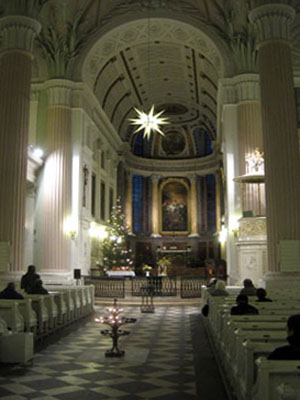 Mahesh & Bonnie Chavda mentioned a prayer meeting the met every Monday at a Leipzig church (100 Year Bloom, 2006., so I looked it up. Here's part of the article in Reuters: “The peaceful revolution that toppled East German communism had roots going back to a prayer. The weekly peace prayer meetings started in 1982 in Leipzig’s Nikolaikirche (Church of St. Nicholas) became a rallying point for dissidents later in the decade. By September 1989, participants leaving the church defied the Stasi and arrest threats to march publicly against the government. On October 9, the protesters feared a ‘Chinese solution’ — i.e. a bloodbath like the one in Beijing the previous summer — but marched anyway out of the Lutheran church and around the city. When the massed security forces did not fire on the marchers, who by then numbered 70,000, the protest movement began to lose its fear. The opening of the Berlin Wall followed only a few weeks later.” (Tom Heneghan. Reuters, 2008).
There is no doubt that much of this was due to political disgust. But the article in Der Spiegel says, “This was no spontaneous flash mob. By the summer of 1989, East German dissidents had been meeting at Leipzig's 800-year-old Nicolaikirche for almost a decade to pray and talk politics. At times there were fewer than a dozen people in the church, but all through the 1980s the meetings happened every Monday without fail. Eventually, they attracted people eager to discuss a wide range of causes, from the environment to the right to travel freely.” (Andrew Curry. "We are the People, A Peaceful Revolution in Leipzig",Der Spiegel).
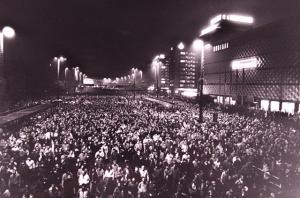 Curry describes the mood as thousands streamed to the cathedral to hear a message and then march out silently holding candles: “Dissidents prepared for the worst. Couples with kids made sure one parent stayed home, in case there was a police crackdown. Rumors flew around the city: Hospitals had been stocked with extra blood and beds; stadiums were readied to hold masses of arrested demonstrators. On his way home from work at the opera house in the middle of town that day, Leipziger Hans Georg Kluge remembers seeing the city filling with soldiers and police. ‘Everyone had to reckon with the state suppressing any demonstration,’ he says. ‘Violently, if necessary.’” Here is the power of years of prayer: not a shot was fired. The East German state shuddered, knowing the hand-writing was on the wall and spilling out into the streets. The Wall was coming down.
The Season of Prayer
2 Samuel 21:14 They buried the bones of Saul and Jonathan his son in the country of Benjamin in Zela, in the grave of Kish his father; thus they did all that the king commanded, and after that God was moved by prayer for the land.
Jeremiah 7:16 As for you, do not pray for this people, and do not lift up cry or prayer for them, and do not intercede with Me; for I do not hear you.
Lamentations 3:44 You have covered Yourself with a cloud So that no prayer can pass through.
2 Chronicles 7:14 and My people who are called by My name humble themselves and pray and seek My face and turn from their wicked ways, then I will hear from heaven, will forgive their sin and will heal their land.
Job 33:26 Then he will pray to God, and He will accept him, That he may see His face with joy, And He may restore His righteousness to man.
Psalm 32:6 Therefore, let everyone who is godly pray to You in a time when You may be found
Joshua 7:10 And the LORD said unto Joshua, Get thee up; wherefore liest thou thus upon thy face?
In one sense our season of prayer began when the first child was born to Adam. We did not awaken to the need until the third generation when Enosh was born to Seth: “To Seth, to him also a son was born; and he called his name Enosh. Then men began to call upon the name of the LORD”. (Genesis 4:26). By this point, it was brutally apparent that the light of God's presence had departed from men. The name ‘Enosh’ is “properly a mortal (and thus differing from the more dignified Adam)” (Strong's H582). Adam is the Hebrew word for man (Strong's H120).
On the other hand, there are times and circumstances where the appropriate Godly action is to walk away, fast. And at other times it is appropriate to go into action. And finally there are times when we are called to prayer. Only by the Holy Spirit will we be doing the right thing at the right time. Perhaps the best example of this is Joshua's prayer before God, when God calls him to his feet to deal with the sin of Aiken (Joshua 7:10).
It deserves its own category, but consider also the ‘seasoning’ for prayer, i.e. attitude. “Something happens in our spirit when we let that attitude of reverence express itself in our prayers.” (Derek Prince, Secrets of a Prayer Warrior. Page 109.) Might I suggest that the insolent, ‘You love me, now give me...’ approach is a poor prayer posture. There is also an attitude of indolence that happens when there is something to do, as when Joshua is called to root out sin in the above example, but for what ever reason the blockage is not being dealt with. Joshua was simply ignorant of the sin, hence indolence is not the issue. In fact, Joshua called on God until God explained the problem. Then he dealt with it. But the point is that approaching God as a child in need of grace, having dealt with any known issues, is more likely to get a good result than approaching God as a ‘King's kid’, or in some other manner which lacks consideration for the Holiness of God.
I don't know if it is included anywhere here, but I read the story of a missionary who had been on the point of death but miraculously recovered. Years later, after delivering an address at an East Coast event in which he had recounted the occassion, he was approuched by a woman who pulled out a diary. She asked the exact date and found an entry in her diary in which she was awoken in the night with an urge to pray desperately for that very missionary. Smith Wigglesworth tells of a similar story regarding Willie Burton, a missionary to the then Belgian Congo (Ever Increasing Faith, Page 210). Moreover, the testimony of a brother I know personally is that he was awoken in the night to pray desperately for a missionary. That missionary, a personal friend of his, was at that moment being interrogated by the Cuban police. While they had threatened to lock him up for life, they released him unharmed. I know this missionary well and have full confidense in this account. I can only say this, if the Spirit awakens you and says pray. Wake up and pray now!
The Prayer of the Anointed
Job 42:8 Now therefore, take for yourselves seven bulls and seven rams, and go to My servant Job, and offer up a burnt offering for yourselves, and My servant Job will pray for you. For I will accept him...
Proverbs 28:9 He who turns away his ear from listening to the law, Even his prayer is an abomination.
Isaiah 1:15 So when you spread out your hands in prayer, I will hide My eyes from you; Yes, even though you multiply prayers, I will not listen. Your hands are covered with blood.
Isaiah 56:7 Even those I will bring to My holy mountain And make them joyful in My house of prayer. Their burnt offerings and their sacrifices will be acceptable on My altar; For My house will be called a house of prayer for all the peoples.
God listens to those who have clean hands and a pure heart. Those who are righteous are good intercessors. Those who are not need to pray to God for their deliverance from evil. Those who embody the graces of patience and forgiveness are heard in Heaven. Peter in giving advice to married couples pointedly says to the men: “You husbands in the same way, live with your wives in an understanding way, as with someone weaker, since she is a woman; and show her honor as a fellow heir of the grace of life, so that your prayers will not be hindered.” (1 Peter 3:7, NASB). You might call this the first level of anointing. The gift of a transformed heart and mind, allows us ever deeper access to the inner court, this is available to all Christians by simply asking (Luke 8:2, Luke 11:9). To say, “Knock and the door will be opened”, is to say pray for the ability to pray well.
“Anointing comes not to the study but to the closet”, says E.M. Bounds. “It is heaven's answer to prayer, the sweetest exhalation of the Holy Spirit. It suffuses, softens, cuts and soothes. It carries the Word like dynamite, like salt, like sugar; it makes the Word a healer, an arraigner, a revealer, a searcher; it makes the hearer a culprit or a saint, makes him weep like a child and live like a giant.” (E.M Bounds, Power Through Prayer. Pages 86-87.)
Anointing is the gift of God, especially to those who open themselves to Him. “The LORD restored the fortunes of Job when he prayed for his friends, and the LORD increased all that Job had twofold” (Job 42:10, NASB). The way to an anointing is to stop trying in your own strength. “First, acknowledge the futility of fighting your spiritual battles with natural strength — exhale all self-dependence. Second, prayerfully inhale his mighty power, asking him to fill you with his fullness.” (R. Kent Hughes, Ephesians, The Mystery of the Body of Christ. 1990. Page 220.)
And finally, anointing is God working through us. Our enthusiasm, brilliance or beauty of speech have nothing to do with anointing. “Often earnestness is mistaken for anointing. The one who has divine anointing will be earnest in the very spiritual nature of things, but there may be great earnestness without the least bit of anointing.” (E.M Bounds, Power Through Prayer. Page 86.)
“The anointing is not the gift of genius. It is not found in the halls of learning. No eloquence can woo it. No industry can win it. No hands can confer it. It is the gift of God--the royal signet given to the King's own messengers. It is heaven's knighthood offered to the chosen true and brave ones who have sought this honor through many an hour of tearful, wrestling prayer.” (E.M Bounds, Power Through Prayer. Page 87.)
“In Christian terms, ‘unction’ is the anointing of the Holy Ghost, separating unto God's work and qualifying for it. This anointing is the one divine enablement by which the Christian accomplishes God's purposes. Without this anointing no true spiritual results are accomplished; the results and forces in ministry do not rise above the results of unsanctified speech and action.” (E.M Bounds, Power Through Prayer. Page 91.)
The anointing begins when we take our place with Christ in the heavenlies. “...when I pray, the Kingdom comes because I am praying with the authorized right to bring Heaven to earth.” (Bill Johnson, When Heaven Invades Earth. Page 195.)
1 Chronicles 5:20 And when they prevailed over them, the Hagrites and all who were with them were given into their hands, for they cried out to God in the battle, and he granted their urgent plea because they trusted in him.
It is always the question, how do I get the anointing? “Draw near to God, and he will draw near to you.” James 4:8. Because Israel had faith in God, they believed God would come to them, because of their longing for His presence, God came. It was just enough faith to move a mountain (of Hitites in this case).
The Struggle to Pray
1 Chronicles 17:25 Your servant has found courage to pray before You.
Ephesians 3:13-17 Therefore I ask you not to lose heart at my tribulations on your behalf, for they are your glory. For this reason I bow my knees before the Father, from whom every family in heaven and on earth derives its name, that He would grant you, according to the riches of His glory, to be strengthened with power through His Spirit in the inner man, so that Christ may dwell in your hearts through faith...
“‘Therefore pray’. Prayer is Labor, not agony, but labor on the ground of our Lord's redemption in simple confidence in Him. Prayer is simple to us because it cost Him so much to make it possible. God grant that we may work His victories for Him by taking His way about it.” Oswald Chambers, My Utmost Devotional Bible. reading 13.
Nehemiah 1:4 When I heard these words, I sat down and wept and mourned for days; and I was fasting and praying before the God of heaven.
Sometimes there is struggle in prayer because there is spiritual resistance. This can be a testing as in Jacob's struggle with the angel, or it might be demonic. It is not uncommon for a weariness, distraction or even sickness to overtake someone who is attempting to engage in consistent prayer. In my experience, prayer that does not meet resistance is probably superficial and self-serving. Some of us pray for others in a way that is window dressing for our own ‘spirituality’. This prayer may flow like a bubbling brook, or burst forth with a pharisee's trumpet sound; it never reaches heaven, and so hell is unconcerned.
On the other hand, heaven may be resisting your prayer. In his discussion on brokenness, i.e. humility before God, Watchman Nee observes: “Until our outward man is shattered, the inward simply cannot be released and come forth. Do not try to oppose and overturn this law and its effects by praying for blessings. Such prayers are vain. Praying can never change God's law… To obey God's law is far better than saying many prayers. It is much better to stop praying and confess: ‘God, I prostrate myself before Thee.’ Yes often our prayers for blessings can actually raise up barriers. We long for God's blessings, but instead we seem to find God's mercy in our crushing experiences.” (Watchman Nee. The Release of the Spirit. 2000. Page 42). Jesse Penn-Lewis suggests that our failure to overcome our ‘easily besetting sins’ places a barrier between us and God, which closes God to our petitions. “An unclouded personal relationship to Christ is the very foundation of answered prayer.” (Penn-Lewis, Prayer and Evangelism. Pages 22-23).
There is a circle of struggle here. In the same way that your prayer power is curtailed by sin and disobedience, a sluggish prayer life leaves the door open to the enemy. “A great secret in maintaining a life of personal victory is to ‘keep short accounts with God’—to quickly seize the weapon of prayer and pray, no matter how you feel. Whatever may be the circumstances, however you may think you are in ‘defeat’, PRAY!” (Penn-Lewis, Prayer and Evangelism. Page 24).
William Gurnall in his classic book The Christian in Complete Armour carries this further, in a sentiment echoed later by Jonathan Edwards, we cannot truly intercede before God without the groanings of the Spirit in our heart: “The Spirit must groan, and then the soul will groan. He helps us to these sighs and groans which turn the sails of prayer. He dissolves the heart and then it [i.e. prayer] bursts out of the heart by groans of the lips by heavenly rhetoric, out of the eyes as from a flood-gate with tears.” (Wm Gurnall. The Christian in Complete Armour. Page 9.). “In the day when I cried thou answeredst me, and strengthenedst me with strength in my soul” (Psalm 138:3).
Another aspect of this is to pray fervently and then quit, believing the work to be done. Recently Bishop Vianney Muhwezi of Uganda spoke of instances when he was warned of certain dangers, which he dutifully prayed for, but the tragedies came to pass anyway. When he went to God about it, God told him that he failed to pray until he received confirmation that the prayer was answered in heaven. This we often refer to as “praying through” until we have a “release”. This is a very strong theme in the book Rees Howells, Intercessor, quoted below. Bishop Muhwezi used the acronym: P.U.S.H. for “Pray Until Something Happens”.
Wrong, Weak or Ineffective Prayer
Job 6:8-9 Oh that I might have my request; and that God would grant me the thing that I long for! Even that it would please God to destroy me; that he would let loose his hand, and cut me off!
If prayer isn't answered, the reason may be that the prayer itself is not in keeping with God's will. I have often heard longwinded addresses to God carefully telling God what He will do, but never asking Him to do anything. I realize there are some out there who believe that God is a heavenly Pinata. Your prayer is like a stick to get God to give up the prize, whatever you want. There is a type of prayer like this, but it has nothing to do with God. Focusing the mind through meditation, visualization, repetition or intense concentration can get you what you want, but the mechanism is not the Holy Spirit, but psychic energy, i.e. witchcraft. Humble prayer places the request in the hand of God… “Not my will, but thine...” (Luke 22:42). God “gives grace to the humble” (1 Peter 5:5).
T.W. Hunt in a small book on prayer, meant as a Baptist guide, deals with the topic of unanswered prayer: “Jesus referred twice in His parables and once again in His teaching to types of unanswerable prayers. The parable of the rich man and Lazarus has the rich man in hades asking that his tongue be cooled and his brothers warned (Luke 16:19-31). This prayer was too late; it involved nothing that all true prayer in the Bible is—it involved no worship of God (Psalm 141:2), and it exhibited no fellowship, no commonality with God. Another of Jesus' parables pictures a self-exalting Pharisee boasting of his righteousness (Luke 18:9-14)… His conclusion is rather chilling: ‘Truly I say to you, they have their reward in full.’ ” (T.W. Hunt, The Doctrine of Prayer. Pages 80-81.)
Hunt continues, “Job's prayer to die (Job 6:8-9) was made in ignorance of the great heavenly council in Job 1 which was to be one of the great proofs of all time of the profound work that God can do in a man's life. Many of our prayers are in ignorance. There is no record of sin in any of Job's prayers. It is interesting that three of the most righteous men in the Bible--Moses, Elijah, and Job--all mistakenly prayed to die. It is also interesting that they received great boons from the Lord following their mistaken prayers.” (T.W. Hunt, Doctrine. Page 81.) It is easy to see how the proud Pharisee or Lazarus in Hell pray, but are not received by God. Here the Bible shows us great men of God whose prayers are not answered because God intends something better for them. We suffer from near-sightedness, but God's vision, like His love, is eternal.
We have all suffered through long-winded prayer, prayers that amount to self-advertizement, or preaching prayers. Smith Wigglesworth takes a rather strong stand on corporate prayer: “Don't spoil the prayer meeting by continuing to pray when you ought to have stoppped. Who spoils a prayer meeting? The person who starts in the Spirit and finishes in the flesh.... Learn to cease immediately when the anointing of the Spirit lifts.” (Wigglesworth, Ever Increasing Faith. Page 161.)
Any discussion of wrong prayer would be a disservice if the impression is left that we should be afraid to pray lest we pray inappropriately. If our prayers are wrong, whether through pain, ignorance, immaturity or distraction, God is not condemning us any more than he condemns Moses, Job or Elijah. Even with selfish prayer, God hears it. Wigglesworth follows the above quotation with, “God wants the assembly to be as free as possible, and you must not hinder the working of the Spirit, or it will surely bring trouble. You must be prepared to allow a certain amount of extravagance in young and newly baptized souls.” (Wigglesworth, Ever Increasing Faith. Page 161.)
With Lazarus, his prayer was too little and too late, but Lazarus is not condemned for his prayer. The condemnation comes for those who exalt themselves in prayer, as with the proud Pharisee. Prayer is to God who alone deserves the glory, for in Him is the power and the glory (Matthew 6:13). Yes, get your heart right before God, but don't wait until you are perfect... pray until you are perfect. Hunt concludes his chapter, “Many times I request prayer of certain people not because I think they ‘have influence with God’ but because I know they will pray.” (T.W. Hunt, Doctrine. Page 86.)
John Mulinde, one of the most recognized figures of the Ugandan revival, points out that the spiritual state in which we pray greatly influences the outcome. “Even when intercessors make prayer for revival or transformation in the nations, so much remains clouded in the mindset of the day that God finds it hard to align our prayers with His heart.” (John Mulinde, Set Apart for God. Page 40.) He goes on to illustrate the extreme from story of Eli and his sons (1 Samuel 2:22-25 & 3:1-18). “One can reach a place where one's heart has grown cold. When that place has been reached, even a very clear word of prophecy will cause that person only to acknowledge that ‘Indeed god has spoken’, but he or she will not repent. People reach the place where they just have no strength left in them to repent.” (John Mulinde, Set Apart. Page 45.)
Gordon Lindsay includes this synopsis of George Muller's five important conditions to prevailing prayer:
“1. Entire dependence on the merit and mediation of the Lord Jesus Christ, as the only ground or claim for blessing. (John 14:13-14).
“2. Separation from all known sin. If we regard iniquity in our hearts, the Lord will not hear us, for it would be sanctioning sin. (Psa 66:18).
“3. Faith in God's Word of promise as confirmed with His oath. (Heb. 11:6).
Asking in accordance with His will. Our motives must be godly; we must not seek the gift of “4. God to consume it on our lusts. (1 John 5:14; James 4:3).
“5. Importunity in supplication. There must be waiting on God and waiting for God, as the husbandman has long patience to wait for the harvest. (James 5:7, Luke 18:1-10).” (Men Who Changed the World, Volume Six. Page 13.)
Prayer of Repentance
Jeremiah 31:9 With weeping they shall come, and with pleas for mercy I will lead them back, I will make them walk by brooks of water, in a straight path in which they shall not stumble, for I am a father to Israel, and Ephraim is my firstborn. [ESV]
Pray for Revival
Acts 2:1-4 And when the day of Pentecost was fully come, they were all with one accord in one place. And suddenly there came a sound from heaven as of a rushing mighty wind, and it filled all the house where they were sitting. And there appeared unto them cloven tongues like as of fire, and it sat upon each of them. And they were all filled with the Holy Ghost, and began to speak with other tongues, as the Spirit gave them utterance.
“There are only two goals necessary for a revival; one is to influence men, the other to influence God. The truth is employed to move men, and prayer to move God.” (Charles Finney, How to Experience Revival. Page 43.)
J. Edwin Orr often said, “Whenever God gets ready to do a great work, He always sets His people a-praying.” (The Rising Revival, 1998. Page 7). Peter Wagner, who quotes Orr above, goes on, “Consider this statement by David Bryant: ‘We may be standing in the vortex of the most significant prayer movement in the history of the church… No generation has ever seen such an acceleration and intensification of prayer worldwide.’ I don't know a single recognized prayer leader who would disagree with Bryant.” (The Rising Revival, 1998. Page 8). The “Transformation” series on revivals, both modern and historical, clearly show the significance of prayer for revival. To make the point, let us look at some of the more important revivals of recent history.
“The Welsh revival was initiated and carried by a devotion to prayer and intercession that also spread throughout the worldwide Christian community. Much of the fire that continues in some of the great prayer movements of today could likely trace their origin to a lingering spark from the Welsh Revival. The prayer and the praise mingled together in most of the meetings. [historian]James E. Stewart wrote:
“‘It was praying that rent the heavens; praying that received direct answers there and then. The spirit of intercession was so mightily poured out that the whole congregation would take part simultaneously for hours! Strangers were startled to hear the young and unlettered pray with such unction and intelligence as they were swept up to the Throne of Grace by the Spirit of God. Worship and adoration was unbounded. Praise began to mingle with the petitions as answered prayer was demonstrated before their very eyes. Often when unsaved loved ones were the focus of the intercession, they would be compelled to come to the very meeting to be saved!’ ” (Rick Joyner, "The World Aflame, 1993. Page 25).
It is said that Evan Roberts, the main figure of the Welsh Revival, would pray all night, arrive at the revival meeting and sit, continuing to pray. When he did get up and speak, he would for a few minutes until the glory of God fell on the place. Then he would go home to pray again while people were still falling under the power. Wales was no stranger to prayer, or to revival for that matter.
South Wales 1871: “The churches had felt the for some time a crippling deadness of soul, and about 1870, at Newport, a prayer meeting was commenced which met every Friday evening. At first this was poorly attended, and prayers for the success of the means of grace and for a general awakening were offered in the midst of much discouragement. The small band persevered, however, and the prayer meetings grew in numbers and fervency. Shortly afterwards the minister's preaching seemed to become more powerful… Undoubtedly the leading feature of this work was the number of prayer meetings which sprang up in many Glamorgan towns.” (Eifion Evans. The Welsh Revival of 1904. Pages 11-12).
Visitation in 1887: “…it was proposed to hold a New Year's week of prayer... A mere six persons attended the first meeting, but as the week progressed an awareness of unusual interest gripped the people, and the prayer meetings were eventually continued for nine weeks. There were no visible results at first, but a distinct turning point was felt at one of the meetings, compared to a pentecostal visitation. From that date there was a steady stream of conversions.” (Eifion Evans, The Welsh Revival. Page 12).
1906, just two years after the beginning of the Welsh Revival, revival broke out at the Azusa Street Mission in the Los Angeles area. How did an unknown black man, William Seymour, turn the world upside down? He had the hunger from hearing the lectures on the Holy Ghost delivered by Charles Parham at classes in Houston, Texas. Listen to Seymour tell it: “Before I met Parham, such a hunger to have more of God was in my heart that I prayed for five hours a day for two and a half years. I got to Los Angeles, and there the hunger was not less but more. I prayed, ‘God, what can I do?’ The Spirit said, ‘Pray more.’ ‘But Lord, I am praying five hours a day now.’ I increased my hours of prayer to seven, and prayed on for a year and a half more. I prayed to God to give what Parham preached, the real Holy Ghost and fire with tongues with love and power of God like the apostles had.” (Eddie L. Hyatt, 2000 Years of Charismatic Christianity. Page 144).
“Prayer seems to have been the foremost activity at the Azusa Mission. One participant said, ‘The whole place was steeped in prayer.’” (Hyatt, 2000 Years. Page 145).
The Shantung Revival of 1930's: “Last year we had two Chinese evangelists with us, who gave us stirring messages, and we saw some souls brought in. But this year we have had the most remarkable revival in the history of this work. There has been almost no preaching, no exhorting—only prayer and the silent powerful work of the Holy Spirit. It began with the confession of sins among the missionaries and the Chinese church leaders.” (Mary Crawford, The Shantung Revival. Page 98.)
This writer notes that the revival in Shantung depended not on aggressive evangelism, but on prayer and submission to the conviction of the Spirit. While we enjoy the feeling of being forgiven at the foot of the cross, we resist the last step into resurrection. She quotes an un-named source: “The Church is not living in Pentacost; the Church stands hesitant between Easter and Pentacost. Hesistant, hence impotent.” (Crawford, Shantung. Page 141.) When we understand that the way to resurrection is the cross, and for each it is different. Andrew Murray was not allowed to finish the doctorate he worked for. For many, as in Shantung, they must expose their shame. Myself, I have had to submit to things I thought were unjust. God is never our debtor. He is faithful and just to generously supply when we open ourselves in trust to His call
. “I had been asking Him to help me in my work. Now I stand by and see Him work His mighty works. I let Him pick me up and use me for His work. He uses me for winning others. O, what a difference!” (Crawford, Shantung. Page 142.)
The Brownsville revival began in 1995. The revival began under the leadership of John Kilpatrick and Steve Hill at the Brownsville Assembly of God. Its foundation was prayer: “In 1988 Pastor Kilpatrick shifted the focus of his life to prayer. the began a special and intimate journey with God, as the Lord taught John Kilpatrick deeper and deeper lessons about the nature of prayer. He began to incorporate fasting into his prayer routine as well, further deepening the well of wisdom God was forming in his spirit.
“All through the early nineties, Kilpatrick led his church in a growing awakening into the power of prayer. By 1993 regular, systematic prayer was firmly entrenched in the congregations's worship routine.” (Marcia Ford. Charisma Reports: The Brownsville Revival. Page 112.).
“...every night, a team of intercessors meets for prayer, joined by pastors and lay people from other churches. Kilpatrick has no intention of eliminating the focus on prayer. ‘If we stopped the prayer meetings, I know this move of God would grind to a halt,’ he said.” (Marcia Ford, Brownsville Revival. Pages 119-120.).
Revival broke out in Argentina in 1982. Several of the key leaders contributed to the book The Rising Revival. The most seasoned leader of this move of God, Omar Cabrera place prayer in the pivotal role: “I was finding that intercessory prayer was of vital importance to our ministry, clearing the way for us to act with the faith that God desired.” (The Rising Revival. Page 95). He goes on, “Evangelizing without actively engaging the enemy in spiritual battle is like trying to row a boat with only one oar.” (The Rising Revival. Page 96).
Perhaps the most stunning example comes from Juan Zuccarelli who chronicles the effort to bring the prisoners to salvation in Argentina's highest security prison, Olmos Prison: “Until a few months ago, we also had five intercessory cell blocks in full operation. However, we sensed that God was telling us to select some brothers from these cell blocks and place them in a new intercessory cell block. We did so with excellent results. Our ordinary cell blocks fast twice a week, from 6:00 A.M. to 6:00 P.M. But the intercessory cell block fasts every day from 6:00 A.M. to 6:00 P.M., and someone there is praying 10 hours every day, apart from the all-night prayer meeting, which is mandatory. That is why, when we submit a prayer request to this cell block, we sleep in peace, because we know that God's answer will come soon.
“Obviously, we put a great deal of emphasis on prayer and intercession. These two activities, together with fasting, are the fundamental columns for our church. Through them, God has worked extraordinary miracles among us. We also place a strong emphasis on holiness.” (The Rising Revival. Page 182).
Olmos Prison was built to hold 1200 prisoners and expanded to hold a total of 1728 prisoners. When that chapter was written Olmos Prison was housing approximately 3200 prisoners. “As of this writing in 1997, there are about 1,480 brothers in Christ the Only Hope Church. Keep in mind this has happened inside the highest security prison in the nation.” (The Rising Revival. Page 179). Zuccarelli reminds us that this being a church inside of a penitentiary, approximately 10 per cent of its members are paroled or moved to other prisons every year. They must grow by one tenth every year just to stay even.
George Otis, Jr. is founder and president of The Sentinel Group which promotes community transformations based on spiritual revival. His group carefully studied revivals to isolate the responsible factors. His conclusion: “persevering leadership and fervent prayer––are present in all of our transformation case studies.” (George Otis, Jr. Informed Intercession, 1999. Page 56.).
Otis is quick to note that there is no formula to establishing a spiritual beachhead, accept that it takes devoted prayer warriors. Several revivals were begun by the prayer of a handful of believers, in some cases only two. “If numbers are not essential to successful intercessory beachheads, spiritual passion is. Believers who wish to position their community for spiritual breakthroughs must pour their hearts and souls into the effort. Unless the church is consumed with a burning desire for divine visitation, united prayer will become merely another project.” (George Otis, Jr. Informed Intercession. Page 62.).
The tool Otis offers for community transformation is spiritual mapping bringing into sharp focus the actual spiritual state of a community. The actual transformation is accomplished by the hard work of joining together and praying. “Spiritual mapping is neither quick nor magical. Demystified, it is a heavy schedule of hard, disciplined work. Those who are not up to community networking, rigorous research and long hours before God in prayer need not apply.” (George Otis, Jr. Informed Intercession. Page 114.).
Evangelist Reinhard Bonnke calls his intercessors the ‘Battering Rams of Intercession’: “the privileged evangelist is the one who has intercessors behind him. Intercessors are the munition workers providing the dynamite for our Gospel bombardment of hell. Intercessors are more than prayer partners, they are ‘Moses people’… [Moses] defended his people by pleading their cause with God.” (Reinhard Bonnke, Evangelism by Fire, 1990. Page 207.).
“…the word intercession first appears in Isaiah 53:12, where the Bible speaks of Christ who ‘made intercession for the transgressors.’ The Hebrew is baga, from the root meaning ‘to impinge with violence.’ ‘Impinge’ means ‘to collide with.’ Vine's Expository Dictionary states that baga means ‘to strike up against, to be violent against, to invade, to come between, to cause to entreat, to meet with, and pray.’ ” (Reinhard Bonnke, Evangelism by Fire. Page 214.).
“Intercession changes your life's attitudes, bringing you a fulfillment so rich it is impossible to describe. Put your heart at God's disposal, not just your time alone, and you will have put your treasure where no moth can take hold.” (Reinhard Bonnke, Evangelism by Fire. Page 216.).
God remembers the future. He has already seen it and determined it. We are tasked, or should I say privileged to make the foretold our now. This is clearly shown when Daniel realizing the prophecy (Israel's release from captivity in Babylon) is due, sets down to pray it into being (Daniel 9:1-4).
We all know the statement ‘History belongs to the intercessor’. Here is the more complete quote from Walter Wink, as quoted in Engels & Briggs book The Jesus Fast. (pg. 191): “Intercessory prayer is spiritual defiance of what is in the way what God has promised. Intercession visualizes an alternative future to the one apparently fated by the momentum of current forces. Prayer infuses the air over time yet to be into the suffocating atmosphere of the present.
“History belongs to the intercessors who believe the future into being… [a future that] belongs to whoever can envision a new and desirable possibility, which faith then fixes upon as inevitable… If we are to take biblical understanding seriously, intercession… changes the world and it changes what is possible to God.”**
Prayer of the Reformers
“Give me Scotland or I die!” John Knox.
“I fear the prayers of John Knox more than all the assembled armies of Europe.” Mary, Queen of Scots.
On Knox's prayer ‘give me Scotland’: “Bissell comments on this prayer: ‘Such prayer goeth not out but from faith and such faith cometh not but by prayer.’ ” (Taking Hold of God, 2011. Pages 63-64.)
“Romans 8:26 says that the Spirit helps with ‘groanings which cannot be uttered.’ What are these groanings? Whose groanings are they? The common Puritan interpretation of Romans 8:26 attributed such groanings to the person praying by the help of the Holy Spirit, and not immediately by the Holy Spirit.” (Taking Hold of God. Johnny C. Serafini, Page 135.)
“In our earnest petitions we do not bring God's will to ours but ours to him. Prayer is a golden chain that reacheth from heaven to earth, and although we think to move God to us, yet we move ourselves to him. As the ship that is fastened with cable doth not bring the haven to it, but itself to the haven, so the change prayer makes is not in God, but in ourselves.” (Taking Hold of God. quoting Anthony Burgess, Pages 98-99.)
“Prayer is a sincere, sensible, affectionate pouring out of the heart or soul to God through Christ, in the strength and assistance of the Holy Spirit, for such things as God hath promised, or according to the Word, for the good of the Church, with submission, in Faith, to the will of God.” (Taking Hold of God. quoting John Bunyan, Page 115.)
“Christians.. pray for the Spirit, that is, for more of it, though God hath endued them with it already.... The Lord in mercy turn the hearts of the people to seek more after the Spirit of Prayer, and in the strength of that, pour out their souls before the Lord.
On the Trinity: “the whole Trinity is glorified by the praying of believers, the Father as the Hearer of prayer, the Sons as the Advocate and Intercessor presenting their prayers to the Father, and the Spirit as the Author of their prayers; Ephesians 2:18, ‘For through him we both have access by on Spirit unto the Father.’ ” (Taking Hold of God. quoting Thomas Boston, Page 167.)
Joel R. Beeke commenting on the work of Thomas Boston, “Prayer is not just a privilege of adoption; it is a sign of the adoption, for it is a fruit of the Spirit of adoption. The Spirit of adoption is ‘a Spirit of prayer,’ Boston says, ‘This casts all prayerless persons that are come to years of discretion, as none of God's children. It also casts all those, who though they have a gift of prayer, and use it too, are strangers to the Spirit of prayer.’ ‘The children of God all praying persons,’ Boston says, ‘There is no child so unnatural as to be still in his father's presence, and never to converse with him.’ ” (Taking Hold of God. Page 168.)
“Prayer brings to fruition the effect of divine adoption, but it also ripens the fruit of adoption. In prayer, Boston teaches the child of God to reflect more deeply upon the One he is privileged to call ‘our Father’ and to seek to know Him more intimately.” (Taking Hold of God,. Beeke paraphrasing Thomas Boston, Page 184.)
“The Spirit, [Jonathan Edwards] said, is the ‘choicest gift,’ the one ‘that God delights to bestow in answer to prayer.’ In fact, ‘God is more ready to bestow this than any other blessing.’ Echoing Psalm 37:4, Edwards believed that if the believer would find his sole prayerful delight in the Lord, God would give him the desires of his heart.” (Taking Hold of God. Peter Beck, Page 201.)
“'Tis evident, that man was made to behold and be delighted with the excellency of God in his works, or in short, to be made happy by beholding God's excellency; as it has been shown that intelligent beings, the consciousness of the creation, must be. But if man was made to delight in God's excellency, he was made to love God; and God being infinitely excellent, he ought to love [him] incomparably more than any man is capable of loving a fellow creature, and every power, and all that is in man, ought to be exercised as attendants on this love.” (Taking Hold of God. quoting Jonathan Edwards, Page 202.)
E. M. Bounds, Power Through Prayer
1 Timothy 2:1-3 I exhort therefore, that, first of all, supplications, prayers, intercessions, and giving of thanks, be made for all men; For kings, and for all that are in authority; that we may lead a quiet and peaceable life in all godliness and honesty. For this is good and acceptable in the sight of God our Saviour;
“An eminent historian has said that the accidents of personal character have more to do with the revolutions of nations than either philosophic historians or politicians will admit. This truth applies to the gospel of Christ; the character and conduct of the followers of Christ can Christianize the world, transfigure nations and individuals.” (E.M.Bounds, Power Through Prayer. Page 15.)
“Real ministry is made in the closet of prayer; God's men and women are made in secret. Their lives and their profoundest convictions are born in their secret communion with God. The burdened and tearful agony of their spirits, their weightiest and sweetest messages come form time alone with God.
“The church today is weak in praying. The pride of learning is against the dependent humility of prayer. Prayer is with the church too often only official—a performance for the routine of service.” (E.M.Bounds, Power Through Prayer. Page 17.)
“Ministry which kills is prayerless ministry. Without prayer we create death, and not life...
Professional praying in the worship service will always exist, but professional praying helps the dead word do its deadly work. Professional praying chills and kills both the word and true prayer.” (E.M.Bounds, Power Through Prayer. Page 29.)
“No learning can make up for the failure to pray. No earnestness, no diligence, no study will supply its lack...
Talking to others for God is a great thing. But talking to God for others is greater still. We will never speak to people for God with real success until we have learned how to speak to God for people.” (E.M.Bounds, Power Through Prayer. Page 36.)
“True praying engages and sets fire every high element of the Christian's being. Prayer is born out of vital oneness with Christ and the fullness of the Holy Ghost. It springs from the deep, overflowing fountains of tender compassion and concern for humanity's eternal good. True prayer is a consuming zeal for the glory of God; it involves a thorough conviction of the difficult and delicate work of the ministry and the imperative need of God's help....only ministry backed by such praying sow the seeds of eternal life in human hearts and builds others up for heaven.”
“We may excuse our spiritual poverty in many ways, but the reason will be found in the lack of urgent prayer for God's presence in the power of the Spirit.” (E.M.Bounds, Power Through Prayer. Pages 40-41.)
“...perhaps little praying is worse than no praying. Little praying is a kind of make-believe, a salve for the conscience, a farce, and a delusion.” (E.M.Bounds, Power Through Prayer. Page 42.)
“Christians who gain lasting results for God are those who have prevailed in their pleadings with God before venturing to plead with others.” (E.M.Bounds, Power Through Prayer. Page 41.)
“A ministry may be a very thoughtful ministry without prayer; we may secure fame and popularity without prayer; our lives may be run with the oil of prayer or with scarcely enough to grease a single cog. But no ministry can be a spiritual one, resulting in holiness, without prayer as an evident and controlling force.” (E.M.Bounds, Power Through Prayer. Page 45.)
“A prepared heart is better than a prepared teaching, for a prepared heart will result in a prepared teaching. ...we do not meditate on God and his Word and watch and fast and pray enough.” (E.M.Bounds, Power Through Prayer. Page 74.)
“He who has prayed well has studied well.” (Martin Luther quoted in E.M.Bounds, Power Through Prayer. Page 76.)
“While the channel of ministry is the mind, its fountain is the heart.” (E.M.Bounds, Power Through Prayer. Page 76.)
“Anointing comes not to the study but to the closet. It is heaven's answer to prayer… The anointing is not the gift of genius. It is not found in the halls of learning. No eloquence can woo it. No industry can win it. No hands can confer it. It is the gift of God—the royal signet given to the King's own messengers. It is heaven's knighthood offered to the chosen true and brave ones who have sought this honor through many an hour of tearful, wrestling prayer.” (E.M.Bounds, Power Through Prayer. Pages 86-87.)
“Give me one hundred preachers who fear nothing but sin and desire nothing but God, and I care not a straw whether they be clergymen or laymen; such alone will shake the gates of hell and set up the kingdom of heaven on earth. God does nothing but in answer to prayer.” (John Wesley quoted in E.M.Bounds, Power Through Prayer. Page 97.)
“If some Christians that have been complaining of their ministers had... risen and stormed heaven with their humble, fervent, and incessant prayers for them, they would have been much more in the way of success.” (Jonathan Edwards quoted in E.M.Bounds, Power Through Prayer. Page 103.)
“Prayer is one of the primary characteristics of strong spiritual leadership. People of powerful prayer are people who mold history. Their power with God has the conquering tread.
... “A prayerless ministry is the undertaker for God's truth and for God's church. We may have the most costly casket and the most beautiful flowers, but it is a funeral nevertheless. Ages of millennial glory have been lost by prayerlessness; the coming of our Lord has been postponed indefinitely by lack of prayer, and hell has enlarged and filled its dire caves in the presence of the dead service of a prayerless church.” (E.M.Bounds, Power Through Prayer. Page 100.)
“Prayer to the pastor or preacher, is not simply the duty of his profession, a privilege; it is a necessity, like air to the lungs. It is absolutely necessary for the spiritual leader to pray. And it is equally necessary that the leader be prayed for. The two propositions are wedded into a union which ought never to know any divorce: the leader must pray; the leader must be prayed for.” (E.M.Bounds, Power Through Prayer. Page 103.)
“Paul, with his clear and full apprehension of spiritual dynamics, determined to make his ministry as impressive, as eternal, as irresistible as the ocean. Paul's pre-eminence in labor and results, in influence on the church and the world, is found in the fact that he was able to center himself and his ministry on the prayers of others.” (E.M.Bounds, Power Through Prayer. Pages 104-105. See: Romans 15:30, Ephesians 6:18-19, Colosians 4:3, 1Thessalonians 5:25, 2Corinthians 1:11, 2Thessalonians 3:1-2, Phillipians 1:19, Philemon 22.)
“The praying ones are to the leader as Aaron and Hur were to Moses––they hold up the hands that decide the outcome of the battle raging around them (Exodus 17:11-13). (E.M.Bounds, Power Through Prayer. Page 106.)
“Spiritual work is taxing work. Praying, true praying, costs an outlay of serious attention and of time, which flesh and blood do not relish. Few persons are made of such strong fiber that they willingly give their all when a surface effort will do. We can accustom ourselves to mediocre praying until it looks acceptable to us. At least it keeps up a decent form and quiets the conscience. But such a habit is a deadly opiate; we can neglect prayer and not notice the danger until the foundations are gone.” (E.M.Bounds, Power Through Prayer. Page 110.)
“Our ability to stay with God in the closet measures our ability to stay with him out of the closet...
“To pray is the greatest thing we can do; and to do it well we must have calmness, time and deliberation.” (E.M.Bounds, Power Through Prayer. Page 111.)
“Non-praying is lawlessness, discord, anarchy. Prayer, in the moral government of God, is as strong and far-reaching as the law of gravitation in the material world, and it is as necessary as gravitation to hold things in their proper sphere and in life.” (E.M.Bounds, Power Through Prayer.)
John Calvin and Martin Luther on Prayer
Chapter 20 of John Calvin's Institutes of the Christian Religion covers prayer. Calvin, whether you agree with him or not, is a very clear thinker, and covers aspects that other writers don't. Moreover, this book is foundational to Reformation theology. It is well worth picking up a copy of the Institutes… just to read chapter twenty.
“Hence the apostle, to show that faith unaccompanied with prayer to God cannot be genuine, states this to be the order: As faith springs from the Gospel, so by faith our hearts are framed to call upon the name of God (Rom 10:14). And this is the very thing which he had expressed some time before, i.e. that the Spirit of adoption, which seals the testimony of the Gospel on our hearts, gives us courage to make our requests known unto God, calls forth groanings which cannot be uttered, and enables us to cry, Abba, Father (Rom 8:26).” (Calvin, Institutes of the Christian Religion, 1599. Book 3, Chapter 20, Section 1. Page 564).
“…nothing is set before us as an object of expectation from the Lord which we are not enjoined to ask of Him in prayer, so true it is that prayer digs up those treasures which the Gospel of our Lord discovers to the eye of faith. The necessity and utility of this exercise of prayer no words can sufficiently express. Assuredly it is not without cause our heavenly Father declares that our only safety is in calling upon his name...” (Calvin, Institutes. Book 3, Chapter 20, Section 2. Page 564).
“But someone will say, Does he not know without a monitor both what our difficulties are, and what is meet for our interest, so that it seems in some measure superfluous to solicit him by our prayers, as if he were winking, or even sleeping, until aroused by the sound of our voice? ...although it is true that while we are listless or insensible to our wretchedness, he wakes and watches for us, and sometimes even assists us unasked; it is very much for out interest to be constantly supplicating him; first, that our heart may always be inflamed with a serious and ardent desire of seeking, loving, and serving him, while we accustom ourselves to have recourse to him as a sacred anchor in every necessity; secondly, that no desires, no longing whatever, of which we are ashamed to make him the witness, may enter our minds,... and lastly, that we may be prepared to receive all his benefits with a true gratitude...” (Calvin, Institutes. Book 3, Chapter 20, Section 3. Pages 564-565).
“Let the first rule of right prayer then be, to have our heart and mind framed as becomes those who are entering into converse with God… What I say, that all foreign and extraneous cares must be dispelled by which the mind might be driven to and fro in vague suspense, be drawn down from heaven, and kept groveling on earth. When I say it must be raised above itself, I mean that it must not bring into the presence of God any of those things which our blind and stupid reason is want to devise, nor keep itself confined within the little measure of its own vanity, but rise to a purity worthy of God.” (Calvin, Institutes. Book 3, Chapter 20, Section 4. Page 565).
(Romans 8:26) Likewise the Spirit also helpeth our infirmities: for we know not what we should pray for as we ought: but the Spirit itself maketh intercession for us with groanings which cannot be uttered.
“…to pray aright is a special gift… Nor, indeed, does Paul, when he enjoins us to pray in the Spirit (1Co_14:15), cease to exhort us to vigilance, intimating, that while the inspiration of the Spirit is effectual to the formation of prayer, it by no means impedes or retards our own endeavors; since in this matter God is pleased to try how efficiently faith influences our hearts.” (Calvin, Institutes. Book 3, Chapter 20, Section 5. Pages 566-7).
“Believers ought to be specially on their guard never to appear in the presence of God with the intention of presenting a request unless they are under some serious impression, and are, at the same time, desirous to obtain it.” (Calvin, Institutes. Book 3, Chapter 20, Section 6. Page 567).
“For the saying of the blind man who had received his sight is in perfect accordance with divine truth—lsquo;God heareth not sinners’ (John 9:31)—provided we take the term sinners in the sense commonly used by Scripture to mean those who, without any desire for righteousness, are sleeping secure in their sins; since no heart will ever rise to genuine prayer that does not at the same time long for holiness.” (Calvin, Institutes. Book 3, Chapter 20, Section 10. Page 570).
“The fourth rule of prayer is, that notwithstanding our being thus abased and truly humbled, we should be animated to pray with the sure hope of succeeding.” “…nothing is more accordant to the nature of prayer than to lay it down as a fixed rule, that it is not to come forth at random, but is to follow in the footsteps of faith.” (Calvin, Institutes. Book 3, Chapter 20, Section 11. Page 571).
“though believers, persuaded of the paternal love of God, cheerfully rely on his faithfulness, and have no hesitation in imploring the aid which he voluntarily offers, they are not elated with supine or presumptuous security; but climbing up the ladder of the promises, still remain humble and based suppliants.” (Calvin, Institutes. Book 3, Chapter 20, Section 14. Page 575).
“It is also of importance to observe, that the four laws of prayer of which I have treated are not so rigorously enforced, as that God rejects the prayers in which he does not find perfect faith or repentance, accompanied with fervent zeal and wishes duly framed.” (Calvin, Institutes. Book 3, Chapter 20, Section 16. Page 576).
quoting Augustine: “Christian men mutually recommend each other in their prayers. But he for whom none intercedes, while he himself intercedes for all, is the only true mediator… For if Paul were a mediator, so would also the other apostles, and thus there would be many mediators, and Paul's statement could not stand, ‘there is one God, and one mediator between God and men, the man Christ Jesus’ (1Tim. 2:5) in whom we are all one (Rom. 12:5) if we keep the unity of the faith in the bond of peace.” (Calvin, Institutes. Book 3, Chapter 20, Section 20. Page 580).
“The sacrifice of praise and thanksgiving can never be interrupted without guilt, since God never ceases to load us with favor upon favor, so as to force us to gratitude, however slow and sluggish we may be.” (Calvin, Institutes. Book 3, Chapter 20, Section 28. Page 586).
“The true object of prayer being, as we have already said, to carry our thoughts directly to God, whether to celebrate his praise or implore his aid, we can easily see that it's primary seat is in the mind and heart, or rather that prayer itself is properly an effusion and manifestation of internal feeling before him who is the searcher of hearts.” (Calvin, Institutes. Book 3, Chapter 20, Section 29. Page 588).
“Let the Christian then so regulate his prayers as to make them common, and embrace all who are his brethren in Christ; not only those whom at present he sees and knows to be such, but all men who are alive upon the earth. What God has determined with regard to them is beyond our knowledge, but to wish and hope the best concerning them is both pious and humane.” (Calvin, Institutes. Book 3, Chapter 20, Section 38. Page 594).
Hallowed be thy name: “…the petition implies a wish that all impiety which pollutes this sacred name may perish and be extinguished, that every thing which obscures or impairs his glory, all detraction and insult, may cease; that all blasphemy being suppressed, the divine majesty may be more and more signally displayed.” (Calvin, Institutes. Book 3, Chapter 20, Section 41. Page 58896).
“He who has prayed well has studied well.” (Martin Luther quoted in E.M. Bounds, Power Through Prayer. page 76).
“Undoubtedly, an essential part of [Luther's] triumph and achievement was prayer. He accomplished much because he prayed much. For Luther, everything must be attained through prayer: ‘Let this be said as an exhortation to pray that we may form the habit of praying with all diligence and earnestness.... Moreover, prayer is in truth highly necessary for us, for we must, after all, achieve everything through prayer: to be able to keep what we have and to defend it against our enemies, the devil and the world. And whatever we are to obtain, we must seek here in prayer. Therefore prayer is comfort, strength, and salvation for us, our protection against all enemies, and our victory over them.’” (Taking Hold of God. Page 24.)
Oswald Chambers on Prayer
Habakkuk 2:1-2 I will stand on my guard post And station myself on the rampart; And I will keep watch to see what He will speak to me, And how I may reply when I am reproved. Then the LORD answered me and said, “Record the vision And inscribe it on tablets, That the one who reads it may run.”
“How steadily all through the Old and New Testament God calls us to stand on the watch and wait for His indications, and how often God's answers to our prayers have been squandered because we do not watch and wait. Are you thoroughly perplexed over God's way? Are you unable to reconcile God's clear way as revealed in His book with the way He is leading you? Take the line of this prophet [Habakkuk], stand and watch to see what God will say – watch at the right place.” (Oswald Chambers. If You Will Ask, 1958. Page 35.) After the waiting, after the vision is written, God is revealed. Then we run. “After Pentecost came the sword and great persecution. The disciples were all scattered abroad, but nothing could stop them from preaching the word. There was a hilarious shout all through these men's lives because of the mighty baptism of the Holy Spirit and fire. There was running then! No power on earth or heaven above or hell beneath could stop the tremendous strength of the child-life of the Holy Spirit in them.” (Oswald Chambers. If You Will Ask. Pages 40-41.)
“Prayer does not fit us for the greater works, prayer is the greater work.” (Oswald Chambers, My Utmost Devotional Bible. Page 1205).
“We can always tell whether our will is in what we ask by the way we live when we are not praying.” (Oswald Chambers. If You Will Ask. Page 12).
“...but when we do pray and devote the dawns to God, His nature in us developes; there is less self-realization and more Christ-realization.” (Oswald Chambers, My Utmost Devotional Bible. Reading 91).
“If He is taking us into the understanding that prayer is for the glorifying of His Father, He will give us the first sign of His intimacy – silence. The devil calls it unanswered prayer. In the case of Martha and Mary, the Spirit of God called it a sign that He loved them, and because He loved them and knew they were fit to receive a bigger revelation than ever they dreamed of, He stayed where He was. God will give us the blessings we want if we won't go any further, but His silence is a sign that He is bringing us into this marvelous understanding of Himself.” (Oswald Chambers. If You Will Ask. Pages 46-47, on John 11:5-6.)
“Jesus Christ separated, or sanctified, Himself by sacrificing His holy Self to the will of His Father; He sanctified His intelligence by submitting His intelligence to the word of His Father, He sanctified His will by submitting His will to the will of His Father. As the sanctified children of God we need to bear in mind that after the experience of sanctification we have to separate our holiness to God. We are not made holy for ourselves, but for God; there is to be no insubordination about us.
“The majority of us are too indifferent, too religiously sentimental, to be caught up in the sweep of the apostle Paul's intercession. Have we a lesser idea than that God should do in us what He wants to do? Are we prepared to pray with Murray McCheyne, ‘Lord, make me as holy as Thou canst make a sinner saved by grace’?
“Some people pray and long and yearn for the experience of sanctification, but never get anywhere near it; others enter in with a sudden marvelous realization. Sanctification is an instantaneous, continuous work of grace; how long the approach to it takes depends upon ourselves, and that leads some to say sanctification is not instantaneous. The reason some do not enter in is that they have never allowed their minds to realize what sanctification means.
“When we pray to be caught up into God's purpose behind this intercession of the apostle Paul, we must see that we are willing to face the standard of these verses. Are we prepared for what sanctification will cost? It will cost an intense narrowing of all our interests on earth, and an immense broadening of our interest in God. In other words, sanctification means an intense concentration on God's point of view – every power of spirit, soul, and body chained and kept for God's purpose only.” (Oswald Chambers. If You Will Ask. Pages 60-61.)
“We think that to be without a master is the sign of a high type of life. Insurgent, impertinent human beings have no master; noble beings have. Myself is apt to be my master; I pray to myself.
“We are all Pharisees until we are willing to learn to intercede. We must go into heaven backward; that phrase means we must grow into doing some definite thing by praying, not by seeing. To learn this lesson of handling a thing by prayer properly is to enter a very severe school. A Christian's duty is not to himself or to others, but to Christ. We think of prayer as a preparation for work, or a claim after having done work, whereas prayer is the essential work.” (Oswald Chambers. If You Will Ask. Page 74.)
“When people come to the Atonement and say, ‘Now I have deliverance in the Atonement, therefore I have no business being sick,’ they make a fundamental confusion, because there is no case of healing in the Bible that did not come from a direct intervention of the sovereign touch of God. When it comes to deliverance from sin, it is not a question of going to God to ask Him to deliver us from sin, it is a question of accepting His deliverance. If we forget that, we take the Lord out of the Atonement and make it an abstract statement and instantly do the Pharisaic dodge of putting burdens on people that they cannot bear.” (Oswald Chambers. If You Will Ask. Pages 75-76.)
“Prayer is usually considered to be devotional and more or less impractical in ordinary life. Our Lord in His teaching always considered prayer work, not preparation for work... The key is not in any of our organizations; the key lies in our hand by our Lord's instruction, ‘Pray ye therefore.’ ” (Oswald Chambers. If You Will Ask. Page 81.)
“There is only one field of service that has no snares, and that is the field of intercession. All other fields have the glorious but risky snare of publicity; prayer has not. The key to all our work for God is in that one word we are apt to despise – ‘Pray.’ And prayer is ‘laborer’ work.” (Oswald Chambers. If You Will Ask. Pages 84-85.)
“‘Pray ye therefore.’ Prayer is labor, not agony, but labor on the ground of our Lord's redemption in simple confidence in Him. Prayer is simple to us because it cost Him so much to make it possible. God grant that we may work His victories for Him by taking His way about it.” (Oswald Chambers. If You Will Ask. Page 85.)
“It is a mistake to interpret prayer on the natural instead of on the spiritual line – to say that prayer is divine because it brings us peace and joy and makes us fell better. This is the mere accident or effect of prayer. There is no real God-given revelation in it. This is the God-given revelation: That when we are born again of the Spirit of God and indwelt by the Holy Spirit, He intercedes for us with a tenderness and an understanding akin to the Lord Jesus Christ and akin to God, that is, He expresses the unutterable for us.” (Oswald Chambers. If You Will Ask. Page 91.)
“When we draw on the human side of our experience only, our prayers become amazingly flippant and familiar, and we ourselves become amazingly hard and metallic. But if we rely on the Holy Spirit, we shall find that our prayers become more and more inarticulate; and when they are inarticulate, reverence grows deeper and deeper, and undue familiarity has the effect of a sudden blow on the face.” (Oswald Chambers. If You Will Ask. Page 92.)
Charles G. Finney, How to Experience Revival
Matthew 9:38 Therefore beseech the Lord of the harvest to send out workers into His harvest.
“To pray effectively you must pray with submission to the will of God. Do not confuse submission with indifference. No two things are more unlike. I once knew an individual who came to a revival. He was cold and did not enter into the spirit of prayer. When he heard the brethren pray as if they could not be denied, he was shocked at their boldness. He insisted on the importance of praying with submission. Yet, it was plain that he confused submission with indifference.
“If the will of God is not known, submission without prayer is tempting God. For all you know your prayer may be the thing on which an event turns. In the case of an impenitent friend, your prayers may be the key to his being saved.
“Christians often amaze themselves when they look back on their ardent, bold prayers spoken in a moment of intense emotion. Yet, these prayers have prevailed and obtained the blessing. And many of these people are among the holiest people I know in the world.
“The temptation to have selfish motives is so strong that there is reason to fear a great many parental prayers never rise above the yearnings of parental tenderness. That is why so many prayers are not answered and why so many pious, praying parents have ungodly children. Prayer for the unsaved must be based on more than sympathy. Missionaries and others often make the mistake of praying only about those going to hell, forgetting prayer about how the unsaved also dishonor God.” (Charles Finney. How to Experience Revival. Pages 44-45.)
Discussing the conduct of the revival in Evans Mills Finney states: “The means used where simply preaching, prayer, and conference meetings, much private prayer, much personal conversation, and meetings for the instruction of earnest inquirers. These, and no other means were used for the promotion of that work.” (The Autobiography of Charles G. Finney. Pages 68-69.)
“I have said more than once that the spirit of prayer that prevailed in those revivals was a very marked feature of them. It was common for young converts to be greatly exercised in prayer. In some instances they were so burdened that they were constrained to pray whole nights, until their bodily strength was quite exhausted for the conversion of souls around them. There was a great pressure of the Holy Spirit upon the minds of Christians and they seemed to bear about with them the burden of immortal souls.
“Not only were prayer meetings greatly multiplied and fully attended, not only was there great reverence in those meetings, but there was a mighty spirit of secret prayer.” (The Autobiography of Charles G. Finney. Page 104.)
“In offering the Lord's Prayer, ‘Thy kingdom come,’ it is plain that sincerity is a condition of prevailing with God. But sincerity in offering this petition implies the thorough consecration of all that we have and all that we are to the building up of Christ's kingdom. To utter this petition in any other state of mind involves hypocrisy and is an abomination.” (The Believer's Secret of Spiritual Power. Page 127.)
“We must evaluate our prayer lives to see if we are meeting these conditions of prevailing prayer:
“1. The inspiration of the Holy Spirit. All truly prevailing prayer is inspired by the Holy Spirit. ‘For we know not what we should pray for as we ought, but the Spirit itself maketh intercession for us with the groanings which cannot be uttered. And He that searcheth the hearts knoweth what is the mind of the Spirit, because He maketh intercession for the saints according to the will of God’ (Romans 8:26, 27). This is the true spirit of prayer. This is being led by the Spirit in prayer. It is the only really prevailing prayer. Unless believers are taught how to pray by the intercession of the Spirit in them, they cannot prevail with God.
“2. Fervency. A prayer, to be prevailing, must be fervent. ‘Confess your faults one to another, and pray on for another, that ye may be healed. The effectual fervent prayer of a righteous man availeth much’ (James 5:16).
“3. Perseverance or persistence in prayer. See the cases of Jacob, of Daniel, of Elijah, of the Syrophoenician woman, of the unjust judge, and the teaching of the Bible generally.
“4. Travail of soul. ‘As soon as Zion travailed, she brought forth her children.’ ‘My little children,’ said Paul, ‘of whom I travail in birth again, till Christ be formed in you.’ This implies that he had travailed in birth for them before they were converted. Indeed, travail of soul in prayer is the only real revival prayer. If anyone does not know what this is, he does not understand the spirit of prayer. He is not in a revival state. Until he understands this agonizing prayer, he does not know the real secret of revival power.
“5. Specific prevailing prayer. It is offered for a definite object. We cannot prevail for everything at once. In all the cases recorded in the Bible in which prayer was answered, it is noteworthy that the petitioner prayed for a definite object.
“6. Meaning what we say. We make no false pretenses; in short, that we are entirely childlike and sincere, speaking out of the heart, nothing more nor less than what we mean, feel and believe.
“7. Believing the good faith of God to keep all His promises.
“8. Guarding against everything that can quench or grieve the Spirit of God in our hearts. We must watch for the answer in a state of mind that will diligently use all necessary means, at any expense, and add entreaty to entreaty.” (The Believer's Secret of Spiritual Power. Pages 138-139.)
“In promoting revivals, Finney showed that prayer was the first and most important means to be used. Prayer, however, must be accompanied by faith, and by a reliance upon the work of the Holy Spirit. The preaching must be direct, earnest; it must show the sinner that he is lost and that he must repent at once by throwing himself upon the mercy of Christ.” (Men Who Changed the World, Volume Five. Page 15.)
P.T. Forsyth, The Soul of Prayer
“The worst sin is prayerlessness. Overt sin, or crime, or the glaring inconsistencies which often surprise us in Christian people are the effect of this, or its punishment. We are left by God for lack of seeking Him.” (P.T. Forsyth, The Soul of Prayer, 1916. Page 11.)
“To be religious is to pray. Bad prayer is false religion. Not to pray is to be irreligious. ‘The battle for religion is the battle for prayer; the theory of religion is the philosophy of prayer.’ In prayer we do not think out God; we draw Him out. Prayer is where our thought of God passes into action, and becomes more certain than thought. In all thought which is not mere dreaming or brooding there is an element of will; and in earnest (which is intelligent) prayer we give this element the upper hand.” (P.T. Forsyth, Soul of Prayer. Page 15.)
“We can offer God nothing so great and effective as our obedient acceptance of the mind and purpose and work of Christ. It is not easy. It is harder than any idealism. But then it is very mighty. And it is a power that grows by exercise. At first it groans, at last it glides. And it comes to this, that, as there are thoughts that seem to think themselves in us, so there are prayers that pray themselves in us. And, as those are the best thoughts, these are the best prayers. For it is the Christ at prayer who lives in us, and we are conduits of the Eternal Intercession.” (P.T. Forsyth, Soul of Prayer. Page 16.)
“Prayer, indeed, is the great means for appropriating, out of the amalgam of illusion which means so much for our education, the pure gold of God as He wills, the Spirit as He works, and things as they are.” (P.T. Forsyth, Soul of Prayer. Page 19.)
“There are fervent prayers which, by making people feel good, may do no more than foster the delusion that natural vigour or robust religion, when flushed enough, can do the work of the kingdom of God. There is a certain egoist self-confidence which is increased by the more elementary forms of religion, which upholds us in much of our contact with men, and
which even secures us an influence with them. But the influence is one of impression rather than permeation, it overbears rather than converts, and it inflames rather than inspires. This is a force which true and close prayer is very apt to undermine, because it saps our self-deception and its Pharisaism.” (P.T. Forsyth, Soul of Prayer. Page 20.)
“The intercession of Christ in heaven is the continuity and consummation of His supreme work on earth. To share it is the meaning of praying in the Spirit. And it has more effect on history than civilization has.” (P.T. Forsyth, Soul of Prayer. Page 23.)
“Prayer is the atmosphere of revelation, in the strict and central sense of that word. It is the climate in which God’s manifestation bursts open into inspiration. All the mediation of Nature and of things sinks here to the rear, and we are left with God in Christ as His own Mediator and His own Revealer. He is directly with us and in us. We transcend these two thousand years as if they were but one day. By His Spirit and His Spirit’s creative miracle God becomes Himself our new Nature, which is yet our own, our destined Nature; for we were made with His image for our ‘doom of greatness.’ It is no mere case of education or evolution drawing out our best. Prayer has a creative action in its answer. It does more than present us with our true, deep, latent selves. It lays hold on God, and God is not simply our magnified self. Our other self is, in prayer, our Creator still creating. Our Maker it is that is our Husband. He is Another. We feel, the more we are united with Him in true prayer, the deep, close difference, the intimate otherness in true love. Otherwise prayer becomes mere dreaming; it is spiritual extemporizing and not converse. The division runs not simply between us and Nature, but it parts us within our spiritual self where union is most close. It is a spiritual distinction, like the distinction of Father and Son in heaven. But Nature itself, our natural selves, are involved in it; because Nature for the Christian is implicated in Redemption. It ‘arrives.’ It is read in a new script. The soul’s conflict is found in a prelude in it. This may disturb our pagan joy.” (P.T. Forsyth, Soul of Prayer. Pages 30-31.)
“Prayer is the native movement of the spiritual life that receives its meaning and its soul only in Eternity, that works in the style and scale of Eternity, owns its principles, and speaks its speech. It is the will’s congenial surrender to that Redemption and Reconciliation between loving wills which is God’s Eternity acting in time. We beseech God because He first besought us.” (P.T. Forsyth, Soul of Prayer. Page 35.)
Praise: “Prayer is not what might be called the increased drone or boom of an unspeakable Om. God the Holy— the God not abysmal [mysterious] but revealed, in whose revelation the thoughts of many hearts are revealed also, and whose fullness makes [reveals] need almost as fast as it satisfies it.” (P.T. Forsyth, Soul of Prayer. Pages 36-37.)
Thanksgiving: “If we think most of the gift, prayer may subtly increase our egoism. We praise for a gift to us. We are tempted to treat God as an asset, and to exploit Him. But true prayer, thinking most of the Giver, quells the egoism and dissolves it in praise.” (P.T. Forsyth, Soul of Prayer. Page 36.)
Petition: “We do not only bring to God desires that rise apart from Him, and that we present by an act of our own; but our desires, our will, as they are inspired are also formed in God’s presence, as requests. They get shape. In thanks we spread out before Him and offer Him our past and present, but in petition it is our future.” (P.T. Forsyth, Soul of Prayer. Page 37.)
“Our prayer is a cry rather than a hymn. It is a quest rather than a tryst. It trembles more than it triumphs. It asks for strength rather than exerts it. How different was the prayer of Christ!... Nothing is more striking in Christ’s life than His combination of selflessness and power. His consciousness of power was equal to anything, and egoism never entered Him. His prayer was accordingly.” (P.T. Forsyth, Soul of Prayer. Page 41.)
“It is a greater thing to pray for pain’s conversion than for its removal. It is more of grace to pray that God would make a sacrament of it. The sacrament of pain! That we partake not simply, nor perhaps chiefly, when we say, or try to say, with resignation, “Thy will be done.” It is not always easy for the sufferer, if he remain clear-eyed, to see that it is God’s will.” (P.T. Forsyth, Soul of Prayer. Page 42.)
“It is in prayer that our real idea of God appears, and in prayer that our real relation to God shows itself.” (P.T. Forsyth, Soul of Prayer. Page 44.)
“Prayer... is the effective work of a religion which hangs upon the living God, of a soul surer of God than of itself, and living not its own life, but the life of the Son of God.” (P.T. Forsyth, Soul of Prayer. Page 57.)
1 Thessalonians 5:17-18 ...pray without ceasing... for this is the will of God in Christ Jesus for you.
“To pray without ceasing is not, of course, to engage in prayer without break. That is an impossible literalism. True, ‘They rest not day and night, saying, Holy, holy, holy, Lord God Almighty, who weft, and art, and art to come.’ But it is mere poverty of soul to think of this as the iteration of a doxology. It is deep calling unto deep, eternity greeting eternity. The only answer to God’s eternity is an eternal attitude of prayer. ...it means the constant bent and drift of the soul—as the Word which was from the beginning (John i. 1) was ‘prÕs ton qeÒn’[with God]. All the current of its being set towards Him.” (P.T. Forsyth, Soul of Prayer. Pages 60-61.)
“Do not say, ‘I cannot pray. I am not in the spirit.’ Pray till you are in the
spirit.” (P.T. Forsyth, Soul of Prayer. Page 62.)
“Do not allow your practice in prayer to be arrested by scientific or philosophic considerations as to how answer is possible. ...prayer is not only a necessity, of faith, it is faith itself in action.” (P.T. Forsyth, Soul of Prayer. Page 64.)
“Prayer is not a frame of mind, but a great-energy. [The intercessor] must rise to conceive his work as an active function of the work of Christ;” (P.T. Forsyth, Soul of Prayer. Page 79.)
“Our Prayer-book, the Bible, does not prescribe prayer, but it does more—it inspires it.” (P.T. Forsyth, Soul of Prayer. Page 79.)
“Prayer in Christ’s name is prayer for Christ’s object—for His Kingdom, and His promise of the Holy Ghost.” (P.T. Forsyth, Soul of Prayer. Page 80.)
“Remember the stress that Christ laid on importunity. Strenuous prayer will help us to recover the masculine type of religion... by importunity something else is meant than passionate dictation and stormy pertinacity— imposing our egoist will on God, and treating Him as a mysterious but manageable power that we may coerce and exploit.... Prayer with us has largely ceased to be wrestling. But is that not the dominant scriptural idea?” (P.T. Forsyth, Soul of Prayer. Pages 81-82.)
“‘Thy will be done’ was no utterance of mere resignation; though it has mostly come to mean this in a Christianity which tends to canonize the weak instead of strengthening them. As prayer it was a piece of active cooperation with God’s will.” (P.T. Forsyth, Soul of Prayer. Page 83.)
“Prayer is wrestling with God. And it is better to fail thus into the hands of God than of man—even than your own. It is a resistance that God loves. It is quite foreign to a godless, selfwilled defiant resistance. In love there is a kind of resistance that enhances it. The resistance of love is a quite different thing from the resistance of hostility. The yielding to one you love is very different from capitulating to an enemy:
“Two constant lovers, being joined in one, Yielding unto each other yield to
none—i.e. to no foreign force, no force foreign to the love which makes them one.
“So when God yields to prayer in the name of Christ, to the prayer of faith and love, He yields to Himself who inspired it, as He swore by Himself since none was greater.” (P.T. Forsyth, Soul of Prayer. Page 87.)
“Does God not will the existence of things for us to resist, to grapple with? Do we ourselves not appoint problems and make difficulties for those we teach, for the very purpose of their overcoming them? We set questions to children of which we know the answer quite well. The real answer to our will and purpose is not the solution but the grappling, the wrestling. And we may properly give a reward not for the correct answer, but’ for the hard and honest effort. That work is the prayer; and it has its reward apart from the solution.” (P.T. Forsyth, Soul of Prayer. Page 88.)
“Let us beware of a pietist fatalism which thins the spiritual life, saps the rigour of character, makes humility mere acquiescence, and piety only feminine, by banishing the will from prayer as much as thought has been banished from it. ‘The curse of so much religion’ (I have quoted Meredith) ‘is that men cling to God with their weakness rather than with their strength.’” (P.T. Forsyth, Soul of Prayer. Page 91.)
“Cast yourself into His arms not to be caressed but to wrestle with Him. He loves that holy war. He may be too many for you, and lift you from your feet. But it will be to lift you from earth, and set you in the heavenly places which are theirs who fight the good fight and lay hold of God as their eternal Life.” (P.T. Forsyth, Soul of Prayer. Page 92.)
“Prayer alone prevents us receiving God’s grace in vain. Which means that it establishes the soul of a man or people, creates the moral personality day by day, spreads outward the new heart through society, and goes to make a new ethos in mankind. We come out with a courage and humanity we had not when we went in, even though our old earth remove, and our familiar hills are cast into the depths of the sea. The true Church is thus co-extensive with the community of true prayer.” (P.T. Forsyth, Soul of Prayer.)
“Prayer is the assimilation of a holy God’s moral strength.” (P.T. Forsyth, Soul of Prayer.)
Harry Emerson Fosdick, The Meaning of Prayer
Psalm 65:2 “O You who hear prayer, To You all men come.”
“A man is cutting himself off from one of the elemental functions of human life when he denies in himself the tendency to pray.” (Harry Emerson Fosdick, The Meaning of Prayer, 1949. page 10.)
“Prayer, left as an undisciplined impulse, inevitably sinks into such a spasmodic and frantic use. ‘When my soul fainted within me, I remembered Jehovah’ (Jonah 2:7). Like the old Greek dramatists, men hopelessly tangle the plot of their lives, until at the end, with a dilemma insoluble by human ingenuity and power, they swing a god from the wings by machinery to disentangle the desperate situation. They use prayer as dues-ex-machina, a last resort when they are in extremity. In one way or another, how many of us must accuse ourselves of this fitful use of prayer! One of the supreme powers of our lives is left to the control of impulse and accident, its nature unstudied, and its exercise untrained.” (Fosdick, Meaning of Prayer. page 14.) “This, then, is the summary of the matter. Deep in every one of us lies the tendency to pray. If we allow it to remain merely a tendency, it becomes nothing but a selfish, unintelligent, occasional cry of need. But understood and disciplined, it reveals possibilities whose limits never have been found.” (Fosdick, Meaning of Prayer. page 17.)
Psalm 63:6-8 “when I remember you upon my bed, and meditate on you in the watches of the night; for you have been my help, and in the shadow of your wings I will sing for joy. My soul clings to you; your right hand upholds me.” (ESV).
Psalm 63:8 “My soul followeth hard after thee...” (KJV).
“Prayer here is not a burden to be borne, an obligation to be fulfilled, something that is due to God and must be paid. Prayer is a privilege; like friendship and family love and laughter, great books, great music, and great art, it is one of life's opportunities to be grasped thankfully and used gladly. The man who misses the deep meanings of prayer has not so much refused an obligation; he has robbed himself of life's supreme privilegeߞfriendship with God.” (Fosdick, Meaning of Prayer. page 24.)
“Prayer is not a ‘good work’ in return for which a blessing is given, as men buy and sell over the counter. Our pious practices are as useless as a Tibetan prayer wheel, unless at the heart of them all is conscious fellowship with Father who cares.” (Fosdick, Meaning of Prayer. page 42.)
“We must pass from thought into spiritual activity, from the ‘industrious squirrel work of the brain’ into an adventure of the soul in the practice of prayer. The Gospel offers a great privilege; prayer appropriates it. In Calvin's vivid figure, ‘Prayer digs out those treasures which the gospel of the Lord discovers to our faith.” (Fosdick, Meaning of Prayer. page 51.)
“Says Walter Savage Landor, the poet, ‘Solitude is the ante-chamber of God; only one step more, and you can be in his immediate presence’. Goethe says, ‘No one can produce anything important unless he isolates himself’.” (Fosdick, Meaning of Prayer. page 54.)
“Prayer cannot change God's purpose, but prayer can release it. God cannot do for the man with the closed heart what he can do for the man with an open heart.” (Fosdick, Meaning of Prayer. page 59.)
“If my hand slacked I should rob God‖since He is fullest good‖Leaving a blank instead of violins” (Harry Emerson Fosdick, Meaning of Prayer. page 61, the words of Antonio Stradivarius, maker of violins, as interpreted by George Elliot.)
“Prayer... when it is at its best, never says, Thy will be changed, but it says tremendously, Thy will be done!” (Harry Emerson Fosdick, Meaning of Prayer. page 62.)
“Even a casual study of the effective servants of the world reveals how much of their vision and stimulus came in the quiet and receptive hours. Prayer gave God his opportunity to speak, for prayer is the listening ear.” (Fosdick, Meaning of Prayer. page 63.)
“We have, then, two fundamentally opposed ideas of prayer: one, that by begging we may change the will of God and curry favor or win gifts by coaxing; the other, that prayer is offering God the opportunity to say to us, give to us, and do through us what he wills. Only the second is Christian.” (Fosdick, Meaning of Prayer. page 65.)
“Nothing makes one more conscious of poverty and shallowness of character than difficulty in praying or attending to prayer.Any thoughts about self, thoughts of evil, daydreams, love fancies, easily find an abode in the mind. But the thought of God and of right and truth will not stay there, except with a very few persons. I fail to understand my own nature in this particular. There is noting which at a distance I seem to desire more than the knowledge of God, the ideal, the universal; and yet for two minutes I cannot keep my mind upon them. But I read a great work of fiction, and can hardly take my mind from it. If I had any real love of God, would not my mind dwell upon him?” (quoting the diary of Benjamin Jowett “the great Master of Balliol” Fosdick, Meaning of Prayer. page 70.)
“Stone walls are not so impenetrable as the veil of moral difference between the clean and unclean. So spiritual alienation between God and man makes fellowship impossible. Of all the evils that most surely work this malign result in man's communion with the Father, the Master specially noted two: impurity–‘Blessed are the pure in heart, for they shall see God’; and vindictiveness, the unbrotherly spirit that will not forgive nor seek to be forgiven–‘If therefore thou art offering thy gift before the alter, and there rememberest that thy brother hath ought against thee, leave there thy gift before the alter, and go thy way, first be reconciled to thy brother, and then come and offer thy gift’ (Matt. 15:23,24)” (Fosdick, Meaning of Prayer. page 76.)
“...if you are averse to pray, pray the more.” (Fosdick, Meaning of Prayer. page 78.)
“The elemental trouble with the prayers of those who fail to find God real is often the very fact that they are seeking for God. No one is prepared to experience the presence of God until he sees that God is seeking for him.” (Fosdick, Meaning of Prayer. page 83.) “The prayerless heart is fleeing from God. Finding God is really letting God find us; for our search for him is simply surrender to his search for us. When the truth of this is clearly seen, prayer becomes real. There is no more talking into empty space, no more fumbling in the dark to lay hold on him. We go into the secret place and there let every fine and ennobling influence which God is sending us have free play.” (Fosdick, Meaning of Prayer. page 84.)
“...if a prayer is left unanswered it is not because the reign of law prevents. It is because there are vast realms where God must not substitute our wish for his plan.” (Fosdick, Meaning of Prayer. page 104.)
“Faith in prayer may be presumptuous and clamorous; it may present ultimatums to the Almighty demanding his acquiescence; it may try to make of prayer a magic demand on God. But prayer in faith asks everything in entire submission to the will of God. It desires never to force its wish on the Eternal Purpose but always to align its wish with the Eternal Purpose.” (Fosdick, Meaning of Prayer. page 105.)
“What discord should we bring into the universe if our prayers were all answered! Then we should govern the world and not God. And do you think we should govern it better? It gives me only pain when I hear the long, wearisome petitions of men asking for they know not what. As frightened women clutch at the reins when there is danger, so do we grasp at God's government with our prayers. Thanksgiving with a full heart—and the rest silence and submission to the divine will!” (Fosdick, Meaning of Prayer. quoting Longfellow's table-talk, page 111.)
“Another reason for denied requests is that we continually try to make prayer a substitute for intelligence and work.” (Fosdick, Meaning of Prayer. page 120.)
“We are lackadaisical in our desires and therefore are not importunate in our prayers. ... Boys on Halloween ring bells and run. So, many of us pray. But any one who has a serious business will wait for an answer to his summons and if need be, will ring again.” (Fosdick, Meaning of Prayer. pages 122-123.)
“...three comprehensive reasons for denied request: the ignorance of our asking, our use of prayer in fields where it does not belong, and the unreadiness of our own lives to recieve the good we seek.” (Fosdick, Meaning of Prayer. page 123.)
“Prayer may be either heavenly or devilish. When we think of a man's dominant desire as in very truth his prayer, we see that Gehazi, with covetous eyes following Naaman to filch his wealth, is praying; that David, with licentious heart putting Uriah at the front of the battle, is praying; that the prodigal seeking the means of his own ruin is praying. None ever found heaven, here or anywhere, without prayer—the dead set and insistent craving of the heart after evil. In any group of men, you may not in this sense divide those who pray form those who do not. All are praying the prayer of dominant desire. The great question is: what are they after? what is their demand on life?” (Fosdick, Meaning of Prayer. page 137.)
“No man can escape the prayer of dominant desire, nor evade the inevitable measurement of his life by his prayer.” (Fosdick, Meaning of Prayer. page 138.)
“We see clearly that many of the speeches addressed to God that we have called our payers are not real prayers at all. They are not our dominant desires. They do not express the inward set and determination of our lives. What we daily seek in the closet is not the thing that daily we are seeking with undiscourageable craving.” (Fosdick, Meaning of Prayer. page 140.)
“Prayer is the soul's sincere desire,
Uttered or unexpressed,
The motion of a hidden fire
That trembles in the breast.” (Fosdick, Meaning of Prayer. page 141.)
“The Master put prayer into the Beatitudes in one of the greatest descriptions to be found in the Bible: ‘Blessed are they that hunger and thirst after righteousness: for they shall be filled!’ (Matt. 5:6). Prayer is hunger and thirst. Prayer is our demand on life, elevated, purified, and aware of a Divine Alliance.” (Fosdick, Meaning of Prayer. page 143.)
Ephesians 6:10-18, ESV “Finally, be strong in the Lord and in the strength of his might. Put on the whole armor of God, that you may be able to stand against the schemes of the devil. For we do not wrestle against flesh and blood, but against the rulers, against the authorities, against the cosmic powers over this present darkness, against the spiritual forces of evil in the heavenly places. Therefore take up the whole armor of God, that you may be able to withstand in the evil day, and having done all, to stand firm. Stand therefore, having fastened on the belt of truth, and having put on the breastplate of righteousness, and, as shoes for your feet, having put on the readiness given by the gospel of peace. In all circumstances take up the shield of faith, with which you can extinguish all the flaming darts of the evil one; and take the helmet of salvation, and the sword of the Spirit, which is the word of God, praying at all times in the Spirit, with all prayer and supplication. To that end keep alert with all perseverance, making supplication for all the saints,”
“Note the surprising conclusion of this warlike passage. the man is armed for conflict and then the climax reads ‘with all prayer.. praying.’ To the Apostle prayer evidently has a warlike aspect. He is writing this passage in prison, where he needs fortitude to endure. In prayer he finds the battlefield where he fights his fears and gains enduring power that he may be able, ‘having done all, to stand.’ ” (Referring to the passage above; Fosdick, Meaning of Prayer. page 147.)
“God's mercy seat is no mere stall set by the vulgar road side, where every careless passer-by may put an easy hand out to snatch any glittering blessing that catches his eye. It stands in the holiest of holies. We can come to it only through veils and by altars of purification. To enter into it, we must enter into God.” (Quoting Phillips Brooks; Fosdick, Meaning of Prayer. page 153.)
“Jesus himself called his enraptured disciples away from the Mount of Transfiguration, where they wished to prolong their glowing experience, and led them down to save a demoniac groveling in the valley (Matt. 17:2-18).” (Quoting St. Augustine; Fosdick, Meaning of Prayer. page 156.)
“We may pray the most when we say the least, and we may pray the least when we pray the most.” (Fosdick, Meaning of Prayer. page 163.)
“...only by the agony of the righteous comes redemption.” (Quoting a prayer of Walter Rauschenbusch; Fosdick, Meaning of Prayer. page 168.)
“Not for a lack of a satisfying philosophy do our prayers run dry, but for a lack of love.” (Fosdick, Meaning of Prayer. page 176.)
“St. Anthony spoke to the point, ‘We pray as much as we desire, and desire as much as we love.’ ” (Fosdick, Meaning of Prayer. page 185.)
William Gurnall, The Christian in Complete Armour
Ephesians 6:12-13 “For we wrestle not against flesh and blood, but against principalities, against powers, against the rulers of the darkness of this world, against spiritual wickedness in high places. Wherefore take unto you the whole armour of God, that ye may be able to withstand in the evil day, and having done all, to stand.”
“The Spirit must groan, and then the soul will groan. He helps us to these sighs and groans which turn the sails of prayer. He dissolves the heart and then it [i.e. prayer] bursts out of the heart by groans of the lips by heavenly rhetoric, out of the eyes as from a flood-gate with tears." 'In the day when I cried thou answeredst me, and strengthenedst me with strength in my soul,’ (Psalms 138:3).” (Wm. Gurnall, The Christian in Complete Armour, 1986. Pages 36-37.)
“First the Spirit stretches Himself upon the soul, as the prophet upon the child; then the soul will begin to kindle and put forth some heavenly heat in its affections. At last the Spirit melts the heart, and prayer flows from the lips of the believer as naturally as tears from the eyes. And although the saint is the speaker, the author of the Prayer is God. So we see that both the strength to pray and the prayer itself are from God.” (Gurnall, Complete Armour. Pages 36-37.)
“When we wrestle against Satan, we wrestle for God; it follows then that our refusal to wrestle against Satan is a passive resistance against God.” (Gurnall, Complete Armour. Page 128.)
Kent Henry, Streaming in Heaven's Flow
John 4:23-24 But the hour is coming, and is now here, when the true worshipers will worship the Father in spirit and truth, for the Father is seeking such people to worship him. God is spirit, and those who worship him must worship in spirit and truth.
Kent Henry is a contemporary worship leader and intercessor out of St. Louis.
“Simply understood, an intercessor is someone who chooses to intervene, someone who steps prayerfully into the affairs of both God and man.
“The true fulfillment of priestly ministry is strongly tied to prayer and intercession. doing the spiritual work of worship, singing and praying the Word of God and interceding is really the essence of the heart of a Kingdom based believer.” (Kent Henry, Streaming in Heaven's Flow, 2013. Page 103.)
“Simply understood, an intercessor is someone who chooses to intervene, someone who steps prayerfully into the affairs of both God and man.
“With all of my heart, I want to live in this holy zeal for the Lord's honor. Every time I lead worship and every time that I pray His honor is the baseline for what I am doing. Simply because of His great sacrifice and glory, He deserves our best voice, our best songs, our best energy and our best attention.” (Henry, Heaven's Flow. Pages 147-148.)
Rees Howells on Intercession
Luke 22:44 And being in an agony he prayed more earnestly: and his sweat was as it were great drops of blood falling down to the ground.
Rees Howells was a powerful intercessor who came out of the Welsh revival of 1904. His life is documented in the book Rees Howells Intercessor written by a younger colleague after Rees's death (Grubb, Rees Howells Intercessor, 1952.)
“The church knows more about the Savior, who was only on the earth thirty-three years, than about the Holy Ghost who has been here two thousand years.” (Rees Howells quoted. Grubb, Rees Howells. Page 35.)
“there are three things to be seen in an intercessor which are not necessarily found in ordinary prayer: identification, agony and authority.” (Grubb, Rees Howells. Page 81.)
Identification: “This is the law of intercession on every level of life: that only so far as we have been tested and proved willing to do a thing ourselves can we intercede for others. Christ is our intercessor because He took the place of each one prayed for.” (Grubb, Rees Howells. Page 93.)
Agony: “The sufferings of others became so painful to him that he was pleading for them as if for himself. That was intercession!” (Grubb, Rees Howells. Page 86.)
Authority: “But with obedience came cleansing, until by the second week, he said, ‘I had become more used to my position, and could see the Holy Ghost binding the devil. I soon realized I was not fighting against flesh and blood, but “against wicked spirits in heavenly places.” ’
“The weeks that followed, as he ‘gave prompt obedience to the Holy Spirit in all things,’ were times of wonderful fellowship, until by the end of the sixth week the Spirit told him the abiding was complete and the victory assured. ‘I was abiding now without being called to abide, walking in the position, and the Lord told be that I could now expect to see this woman make a move.’ ”
“That very night, with a thrill in his soul, Rees saw her in the open air meeting for the first time, and he told the devil, ‘Now I know that the Holy Ghost is stronger than you; you have been brought to naught on Calvary.’ ” (Grubb, Rees Howells. Page 65.)
Bill and Beni Johnson on Prayer
John 16:24 Hitherto have ye asked nothing in my name: ask, and ye shall receive, that your joy may be full.
“God has made Himself vulnerable to the desires of His people” (Bill Johnson, Dreaming With God,2006. page 23).
“No wonder there's been so little joy in the church. Joy is the result of our redeemed heart revelling in its participation in God's unfolding plan for the earth through prayer.” (Johnson Dreaming. Page 32).
“agreement with God releases God to accomplish His purposes in and through us to the world around us.” (Johnson Dreaming. Page 49).
“At some point it has to stop being about us long enough to utilize the benefits of being in Christ for the sake of those around us.” (Johnson Dreaming. Page 67).
“Every believer is in full time ministry—only a few have pulpits in sanctuaries... Be sure to preach only good news. And when necessary, use words.” (Johnson Dreaming. Page 89).
“With our speech we design and alter our environment.” (Johnson Dreaming. Page 158).
“Intimacy is the main purpose of prayer.” (Bill Johnson, When Heaven Invades Earth, 2003. 64).
“Travailing in prayer is not always a sign of true intercession. Many are not yet able to distinguish the difference between the burden of their own unbelief and the burden of the Lord. I now pray until I come to a place of faith for that situation.” “You only have authority over the storm you can sleep in.” (Johnson, Heaven Invades. 66).
“…when I pray, the Kingdom comes because I am praying with the authorized right to bring Heaven to earth.” (Johnson, Heaven Invades. 195).
“When I pray from the heart of God, I become so lost in the presence of God that it feels like the only thing I am listening to is the voice of God.… When I am in that place, all I have to do is agree with God and partner with the things that are already on His heart.” (Beni Johnson, The Happy Intercessor, 2009. 36-37).
“As intercessors, we need to always remember that we are playing on an offensive team. On an offensive team, the entire team knows where the ball will go and who will catch it.” (Johnson, Happy Intercessor. 40).
“Our job is not to spend all of our time worrying about the enemy's strategies. We are to make the plays that God calls.” (Johnson, Happy Intercessor. 41).
“I stay focused on God and not on the crisis. When you move your prayers into fear, you can't possibly get a clear handle on how to pray according to how Heaven is praying.” (Johnson, Happy Intercessor. 49).
“Intercessors should be the happiest people on the planet because they know the plans of God.” (Johnson, Happy Intercessor. 75).
“Prayers that are fear-based are not prayers that will produce a heavenly answer.” (Johnson, Happy Intercessor. 96).
“The airways are the spiritual climate over a city. It is our responsibility to take ownership of the airways and reclaim the atmosphere.” (Johnson, Happy Intercessor. 101).
“Many of the stories that you will read in this book are the result of taking over the spiritual climate of our city.” (Johnson, Happy Intercessor>. 103).
“Satan's world is full of labor and striving. If we step into that realm, we will only experience burnout.” (Johnson, Happy Intercessor. 128).
“She [a young intercessor] told me in a singsong voice that there were a lot demons here and that it was really easy to pray.” (Johnson, Happy Intercessor. 130).
R.T. Kendall, Did You Think to Pray?
James 4:2 You desire and do not have, so you murder. You covet and cannot obtain, so you fight and quarrel. You do not have, because you do not ask.
“You and I cannot get away with unholy living and then expect to enjoy intimate fellowship with the Father when we have time alone with God in Prayer. And since the Bible and prayer go together, we are faced with this fact: We must respect the Holy Spirit in our public and private lives day and night. We respect Him by avoiding anything that might grieve Him.” (R.T. Kendall, Did You Think to Pray? 2009. Pages 49-50).
“The main thing we learn from the Lord's Prayer, I think, is that we are primarily to seek God's Face, not His hand.” (Kendall, Did You Think. Page 86).
“The longest journey for all of us is from the head to the heart. Saving faith has emerged when the confession with your mouth is matched by belief in your heart.” (Kendall, Did You Think. Page 137).
“Why pray? God chose to honor our obedience. Logic says that since he knows our need and promised to supply it, there is no need to pray. God doesn't honor our logic; He honors our obedience.” (Kendall, Did You Think. Page 185).
Andrew Murray on Prayer
Luke 11:1 It happened that while Jesus was praying in a certain place, after He had finished, one of His disciples said to Him, "Lord, teach us to pray just as John also taught his disciples."
Amid the painful consciousness of ignorance and unworthiness, in the struggle between believing and doubting, the heavenly art of effective prayer is learned..
"He teaches by giving not only thoughts of what to ask or how to ask, but by breathing into us the very spirit of prayer and living within us as the Great Intercessor." (Andrew Murray, With Christ in the School of Prayer, 1981. Pages 13-14).
“Worship in spirit and in truth: In truth does not only mean in sincerity. Nor does it only signify accordance with the truth of God's Word. The expression is one of deep and Divine meaning. Jesus is ‘the only-begotten of the Father, full of grace and truth.’ ‘The law was given to Moses; grace and truth came by Jesus Christ.’ Jesus says, ‘I am the truth and the life.’ The Old Testament was all shadow and promise, Jesus brought and gives the reality, the substance of things hoped for. In Him the blessings and powers of the eternal life are our actual possession and experience.” (Murray, With Christ. Page 20).
“The Atmosphere in which we breath and pray is God's Father-love, God's infinite Fatherliness. thus each thought or petition we breathe out will be in simple, hearty, and childlike trust in the Father. The Master teaches us to pray by bringing us into the Father's living presence. What we pray there must be of value. We should listen carefully to hear what the Lord has to say to us.” (Murray, With Christ. Pages 24-25).
“There are two sorts of prayer: personal and intercessory. The latter ordinarily occupies the lessor part of our time and energy. This should not be. Christ has opened the school of prayer especially to train intercessors for the great work of bringing down by their faith and prayer, the blessings of His work and love to the world. There can be no deep growth in prayer unless this is our aim.” (Murray, With Christ. Page 32).
“Prayer is an appeal to the friendship of God. If we are God's friends and go as friends to Him, we must prove that we are friends of the needy. God's friendship to us and ours to others go hand in hand.” (Murray, With Christ. Page 61).
Commenting on prayer Jesus gives the example of man pressing his neighbor for bread in the middle of the night (Luke 11:5-8). Murray states, “The parable is a perfect storehouse of instruction regarding true intercession...” for it outlines the love for another, the need, the confidence to ask, the unexpected refusal and the perseverance which lead to a satisfactory outcome. (Murray, With Christ. Page 61).
“Once the believer has accepted the will of God, as revealed through the Word and the Spirit, as his will, too, then it is the desire of God that His child use this renewed will in His service. The will is the highest power of the soul.” (Murray, With Christ. Page 78. Emphasis added).
“The whatsoever is unconditional except for what is implied in the believing. Before we can believe, we must find out what God's will is. Believing is the exercise of a soul surrendered to the influence of the Word and the Spirit. Once we believe, nothing is impossible.” (Murray, With Christ. Page 83. Commenting on Mark 11:24 "Whatever you ask...").
“The faith that can overcome stubborn resistance such as you have just seen in this evil spirit, Jesus tells them, is not possible except for men living in very close fellowship with God and in very special separation from the world - in prayer and fasting. And so He teaches us two lessons in regard to prayer of deep importance. The one is that faith needs a life of prayer in which to grow and keep strong. The other is that prayer needs fasting for its full and perfect development.” (Murray, With Christ. Page 98. Commenting on Mathew 17:19-21 "Faith as a grain of mustard seed...").
“It is quite evident that Paul perceived himself as the member of a Body whose sympathy and cooperation he depended on. He counted on the prayers of these churches to gain for him what otherwise might not be given. The prayers of the Church were to him as real a factor in the work of the Kingdom as the power of God.” (Murray, With Christ. Page 115. see: Romans 15:30; 2 Corinthians 1:11; Ephesians 6:18-19; Philippians 1:19; Colosians 4:3 and 2 Thessalonians 3:1-2).
“...beware of rejoicing in beautiful thoughts and happy feelings, while the heart, with its desire and will and love, is not wholly given up to God. In our intercourse with God, everything depends on the heart. It is with the heart man believeth and receiveth the salvation of God.” (Murray, The Holiest of All, 1996. Page 123).
“Living for the glory of God is the condition of the prayers that Jesus can answer.
...Only the presence and rule of the Lord Jesus in our hearts can cast out all self-glorification, replacing it with His own God-glorifying life and spirit.” (Murray, With Christ. Page 148).
“What Gods words are to me is the test of what He Himself is to me. It shows the uprightness of my desire to meet Him in prayer.” (Murray, With Christ. Page 162. see: John 15:7).
“Obedience and faith are simply two parts of one act--surrender to God and His will. As faith strengthens itself in order to be obedient, it is in turn strengthened by obedience. Faith is made perfect by works. Often our efforts to believe are unsuccessful because we don't assume the only position in which a large faith is legitimate or possible--that of entire surrender to the honor and the will of God. The man who is entirely consecrated to God and His will finds the power to claim everything that His God has promised to be for him.” (Murray, With Christ. Pages 171-172. Comment on John 15:16 & James 5:16).
“We are one; we have one life and one Spirit with Him. For this reason we may proceed in His Name. Our power in using that Name, whether with God, men, or devils, depends on the measure of our spiritual life-union with Christ. Our use of His Name rests on the unity of our lives with Him.” (Murray, With Christ. Page 179. Comment on John 14:13, & 15:16).
Luke 17:6 And the Lord said, If ye had faith as a grain of mustard seed, ye might say unto this sycamine tree, Be thou plucked up by the root, and be thou planted in the sea; and it should obey you.
“In the teaching of our Lord on this last night (John, chapter 17), we recognize that these astonishing prayer-promises have not been given for our benefit, but in the interests of the Lord and His Kingdom.” (Murray, With Christ. Pages 200-201). “Christ the Son has the right to ask whatever He chooses. Through our abiding in Him and His abiding in us, His Spirit breathes in us what He wants to ask and obtain through us. We pray in His name. The prayers are as much ours as they are His.” (Murray, With Christ. Pages 222-223).
“...we are apt to forget that the blessing of our church-going depends on our doing two things. First, praying for the preacher that he may speak ‘in the demonstration of the Spirit and of power.’ Second, praying for the congregation and for ourselves that we may receive God's Word, ‘which effectually worketh also in you that believe.’ (I Thessalonians 2:13).
“Often there is no manifestation of the Spirit because the speaking and the hearing are the work of human understanding or feeling.” (L.G. Parkhurst, Jr., editor, The Believer's Secret of Spiritual Power, 1987. Pages 119-120.)
Watchman Nee, The Prayer Ministry of the Church
Luke 5:15-16 “But so much the more went there a fame abroad of him: and great multitudes came together to hear, and to be healed by him of their infirmities. And he withdrew himself into the wilderness, and prayed.”
“Prayer is the church saying to God, ‘God we want your will.’ Prayer is the church knowing what's in God's heart and opening its mouth to ask for what is in God's heart. If the church does not do this, it does not have much use on earth.”
“A prayer which is in the nature of work or ministry is one in which you stand on God's side, wanting what God wants. Brothers and sisters, if a prayer is uttered according to God's will, it is the most powerful thing.... For the church to pray means that it stands on God's side to declare that man wants what God wants.” (Watchman Nee, The Prayer Ministry of the Church, 1993. Page 13).
“The prayer of the church is the outlet of heaven.” (Nee, Prayer Ministry. Page 20).
“If we see the church's responsibility of prayer, we will see that our prayers are not big enough; we are limiting God and frustrating His work.” (Nee, Prayer Ministry. Page 22).
“The purpose of our prayer is not to inform God of something but to show Him our trust, our faith, our dependence, and our wish. Therefore, it is right that we should pray. But when we pray, our desire should exceed our words, and our faith should exceed our words.” (Nee, Prayer Ministry. Page 31).
Matthew 6:9-13 Pray, then, in this way: ‘Our Father who is in heaven, Hallowed be Your name. Your kingdom come. Your will be done, On earth as it is in heaven. Give us this day our daily bread. And forgive us our debts, as we also have forgiven our debtors. And do not lead us into temptation, but deliver us from evil. [For Yours is the kingdom and the power and the glory forever. Amen.]’
“The First Desire: ‘Your Name Be Sanctified’ When a man takes the name of God in vain, God does not show His wrath by striking him with thunder. He hides Himself, as if He did not exist.... If anyone takes God's name in vain, you will feel hurt, your desire will be even stronger, and you will pray even more earnestly: ‘Your name be sanctified’.” (Nee, Prayer Ministry. Pages 32-33).
The Second Desire: ‘Your Kingdom Come’ “May the church pray like the saints of old, ‘O Jehovah bow Your heavens down and descend’ (Psa. 144:5). ‘Oh that You would rend the heavens, that You would come down .’ (Isa. 64:1).” (Nee, Prayer Ministry. Page 35).
The Third Desire: ‘Your Will Be Done, As In Heaven, So Also On Earth’ “Many people have the wrong concept that the reason man prays to God is to initiate something and ask God to do something. But the Bible shows us that God first has a will and wants to do something, next He shows us His will, and then we speak out with our mouth the will that we have come to understand. This is prayer.” (Nee, Prayer Ministry. Page 36).
“God's will is like a river, and our prayer is like the channel. If our prayer is big, the accomplishment will also be big. If our prayer is limited, the accomplishment of our prayer will also be limited.” (Nee, Prayer Ministry. Page 37).
Personal needs: “The Lord wants us to ask God for our bread day by day because He wants us to learn to look to the Father day by day. He wants us to exercise our faith day by day.” (Nee, Prayer Ministry. Page 39).
“Lastly, the Lord taught us to give praise for three things: ‘For Yours is the kingdom and the power and the glory forever. Amen.’ ” (Nee, Prayer Ministry. Page 43).
“The real issue is whether or not we are living before God and whether we are standing on the proper ground. If we are standing on the right ground, we see that the Lord's name is in our hand.... This is God's commitment to us.” (Nee, Prayer Ministry. Pages 57-58).
“A prayer with authority has heaven as its starting point and the earth as its destination.... If a man has never learned the prayer that prays downward, he has never learned to pray with authority. In the spiritual warfare, the kind of prayer that prays downward is very important.” (Nee, Prayer Ministry. Page 64).
“How can the church have... prayer with authority? It is by the church having full faith, being without doubt and being clear that what we do is fully according to God's will. Whenever we are not clear about God's will, we do not have faith.” (Nee, Prayer Ministry. Page 67).
“The most important work of the overcomers is to bring the authority of the throne to earth.” (Nee, Prayer Ministry. Page 67).
“If God is to have a group of overcomers, there must be warfare in prayer.” (Nee, Prayer Ministry. Page 69).
Daniel 9:3 “Then I turned my face to the Lord God, seeking him by prayer and pleas for mercy with fasting and sackcloth and ashes.”
“Prayer is to to seek for God, while fasting is to deny the self. We have to seek God and deny the self at the same time.” (Nee, Prayer Ministry. Page 74).
“Many people are enthusiastic about attending preaching meetings, Bible study meetings, and other meetings of the church. They are interested in these meetings and make time for these meetings. But whenever there is a prayer meeting the number is amazingly low. Despite many sermons that remind us that our chief service is prayer and that if we fail in our prayer life, everything else will fail, we still neglect prayer and consider it to be something quite dispensable. Despite the facts that problems are piling up and that we acknowledge with our mouth that prayer is the only way to solve them, we talk more than we pray, and we worry and resort to methods more than we pray.” (Nee, Prayer Ministry. Pages 75-76).
“Brothers and sisters, we must fight for the time to pray, and we must secure a time to pray. If we wait until we have time to pray, we will never have the opportunity to pray. We must set aside a time to pray. Andrew Murray said, ‘Those who do not have a set time to pray do not pray.’ ” (Nee, Prayer Ministry. Page 79).
“One brother mentioned a story he read in the biography of Evan Roberts [leader of the Welsh Revival]. Once a few people were in his home praying for something. Halfway through one brother's prayer, Mr. Roberts went over and covered his mouth, saying, ‘Brother don't go on. You are not praying.’ The brother reading this story said within himself ‘How could Mr. Roberts do this?’ But later he realized that Mr. Roberts was right. Many words in our prayers are spoken by the flesh through the instigation of Satan. These prayers may be long, but many of them are impractical and useless.”... “Hense when we pray, we have to be watchful and not spend too much time or give too many reasons. Rather, we should speak what is in our heart to God in a sincere way.” (Nee, Prayer Ministry. Page 81).
“Satan's strategy is either to hold us back so that we do not pray or push us forward while we pray so that the more we pray the more we are lost.... We have to guard ourselves from praying the prayers that are not prayers at all.” (Nee, Prayer Ministry. Page 82).
“We have to pray thoroughly for people, for things, for the truth, and for our problems. Brothers and sisters, we have to realize that a hasty ‘economical’ prayer is often a careless prayer that will give ground to Satan.” (Nee, Prayer Ministry. Page 84).
“...we must be watchful to fight for a time to pray, to gaurd prayer, to stop prayers that are not prayer, and to be on guard against Satan's strategy to cut off our prayer. We must remember that prayer is a service, an excellent service. We have to watch and pray, and we must practice conscientiously, so that Satan will not have the opportunity to destroy our prayer.” (Nee, Prayer Ministry. Pages 86-87).
J.I. Packer on Prayer & Knowing God
“Yet the invariable fruit of true knowledge of God is energy to pray for God's cause—energy, indeed, which can only find an outlet and a relief of inner tension when channeled into such prayer—and the more knowledge, the more energy! By this we may test ourselves.... If, however, there is in us little energy for such prayer, and little consequent practice of it, this is a sure sign that as yet we scarcely know our God.” (J.I.Packer, Knowing God, 1973. Page 29).
“The Father is always accessible to his children and is never too preoccupied to listen to what they have to say. This is the basis of Christian prayer.” (Packer, Knowing God. Page 212). The context of this quotation is that it comes in a chapter on sonship, which follows Packer's discussions of God's wrath, God's jealousy, and the nature of propitiation. I recommend the entire four or five chapters if the whole book is too much to digest.
“The mysterious reality of the Holy Spirit's help in prayer becomes known only to those who actually pray.” (J.I.Packer, Concise Theology, 1993. Page 189).
Jessie Penn-Lewis, Prayer & Evangelism
“Prayer is work, and a work which, in its accomplishment, is the expression of the will of God.” (Jessie Penn-Lewis, Prayer & Evangelism, 1995. Page 7).
“Many are willing to give themselves to the work of talking—but how few to the work of praying? If you will stand at the back of someone you see has a real message and pray, ‘Lord, give him utterance, let Thy Word run’—that is the WORK of prayer.” (Penn-Lewis, Prayer & Evangelism. Page 16).
“Many Christians attend the prayer meeting to get right with God, or to get in communion with God; they ought to have lived in that all day, and should go to the meeting for definite work.” (Penn-Lewis, Prayer & Evangelism. Page 17).
“An unclouded personal relationship to Christ is the very foundation of answered prayer.” (Penn-Lewis, Prayer & Evangelism. Pages 22-23).
“A great secret in maintaining a life of personal victory is to ‘keep short accounts with God’—to quickly seize the weapon of prayer and pray, no matter how you feel. Whatever may be the circumstances, however you may think you are in ‘defeat’, PRAY!” (Penn-Lewis, Prayer & Evangelism. Page 24).
“The fundamental personal conditions for a life of continual answer to prayer are therefore: (1) A cleansed heart—no love of sin; (2) ‘planted into His death’ as your permanent footing; (3) union with the Living Christ; (4) His Word abiding in you as your innermost food and life; (5) petition governed by the will rather than the feelings; (6) faith; (7) no self-motive; and (8) praying in spirit by the power of the Holy Spirit.” (Penn-Lewis, Prayer & Evangelism. Page 34).
“It takes a deeper spiritual life to pray than to work, for the flesh can be very active for God and apparently accomplish great results. Lack of power in prayer drives us to human resources. To ‘only pray’ seems folly! This is simply because we have no power in prayer.” (Penn-Lewis, Prayer & Evangelism. Page 37).
>
“The powers of darkness must be met on their own ground. We may account ourselves ‘dead indeed unto sin’ and yet give the strong man much advantage by walking after the life of nature, i.e. our own thoughts, our own plans, our own energy. The natural cannot contend with the supernatural (see 2 Corinthians 10:4). It may appear to do much, and the enemy will go so far as to cause apparent ‘fruit’ if by such means he can keep us striving on a plane where the results are only exterior and bereft of spirit life.” (Penn-Lewis, Prayer & Evangelism. Pages 68-69).
Derek Prince, Secrets of a Prayer Warrior
“When we learn to pray, then we are qualified to rule.” (Derek Prince, Secrets of a Prayer Warrior, 2009. Page 22).
“Just as the Holy Spirit leads us to understand God's will in Scripture, so He leads us in praying it back to God.... Additionally, if these ones shall symphonize—come together in perfect harmony—concerning anything that they shall ask, then it will be done for them.... He has tied Himself only to those who are led by the Spirit of God to come into His name.” (Prince, Secrets. Page 68).
Isaiah 60:18 “you will call your walls salvation, and your gates praise.” (NASB)
Psalm 100:4 “Enter His gates with thanksgiving And His courts with praise. Give thanks to Him, bless His name.” (NASB)
“The instrument that most people mean when they talk about ‘prayer’ is petition, asking for physical and material needs to be met. But remember: Praying is not just thinking of anything we want and asking for it. Praying is discovering God revealed purpose in Scripture, and then praying for the outworking of that purpose.
“Look again at 1 John 5:14-15: ‘Now this is the confidence that we have in Him, that if we ask anything according to His will, He hears us. And if we know that He hears us, whatever we ask, we know that we have the petitions that we ask of Him.’ ” (Prince, Secrets. Page 74).
“It is not just asking that is important, but asking and receiving. I have seen this many times. God touches someone with a healing touch, but the person does not receive it. One way not to receive an answer to a petitiion is to go on praying for it. Some people pray themselves into faith and then pray themselves out of faith.” (Prince, Secrets. Pages 74-75).
Mark 11:24 “Therefore I say to you, all things for which you pray and ask, believe that you have received them…” (NASB)
“Notice this, though: Receiving is not the same as having. Receiving is settling it; having is the experience that follows. The actual experience of having what we have prayed for may have to wait, but by faith we receive what we pray for when we pray.” (Prince, Secrets. Page 75).
Prince goes on to describe the essential ingredient between receiving and actual experience: “Keep the plug in.… How do you do that? Basically, by thanking God. If you have made a petition regarding physical healing, for instance, you say, ‘Thank You, Lord. Your supernatural power is at work in my body.’ And as you respond that way, the healing is completed.” (Prince, Secrets. Page 76. Get the book, there are examples following.)
“Intercession is one of the highest arts of Christian life, one of the most difficult instruments to play. It requires a lot of practice, a lot of skill, a lot of maturity. To intercede means literally ‘to come in between.’ The intercessor is one who comes in between God and those for whom he is praying.” (Prince, Secrets. Page 79).
“the most influential people on earth today are those who know how to get their prayers answered.” (Prince, Secrets. Page 105).
“Something happens in our spirit when we let that attitude of reverence express itself in our prayers.” (Prince, Secrets. Page 109).
“Through the new birth and through the grace of God we can be released from that prison of self-centeredness and into a relationship with Him in which what God wants is more important than what we want.” (Prince, Secrets. Page 110).
“Prayer is not a way for us to get God to do what we want. A lot of Christians think it is. It may work out that way, but that is not its purpose. Prayer is a way for us to become instruments for God to do what He wants. When we become aligned with God's purpose, we are going to pray prayers that are irresistible. There will be no power, human or satanic, that will be able to resist the outworking of our prayer.” (Prince, Secrets. Page 115).
“There are only two alternatives about prayer. Either God answers prayer or He does not. If He does not answer prayer it is foolish to pray, and if He does answer prayer it is foolish not to pray.” (Prince, Secrets. Page 119).
“When you find your place in the Body, then your allotted proportion of faith that God has given you will make you successful in that place.” (Prince, Secrets. Page 125).
Daniel 10:12-13 “Then he said to me, ‘Do not be afraid, Daniel, for from the first day that you set your heart on understanding this and on humbling yourself before your God, your words were heard, and I have come in response to your words.But the prince of the kingdom of Persia was withstanding me for twenty-one days; then behold, Michael, one of the chief princes, came to help me, for I had been left there with the kings of Persia.’...” (NASB)
“Notice also that the initiative is with earth, not heaven. Daniel started the whole thing moving. And I venture to say, in certain respects this remains true today. We are not waiting for God; God is waiting for us. When we move, heaven will move. Then will come the conflict, and our prayers on earth will settle it. We who are believers and know how to pray are much more important than most of us have the faintest idea.” (Prince, Secrets. Page 132).
Prince makes another important statement concerning the quote above from the book of Daniel: “This shows that earth's empires have their counterpart in Satan's empire. In other words, Satan seeks to control the empires of earth through its rulers in order to make its leaders and governments instruments of his will. We must pray for our governments in order to frustrate Satan and to bring our governments under heaven's control.
“That is why Paul said first of all—before you pray for the sick, the missionaries, the evangelist, even your family—to pray for the government. As we have seen, anyone who criticizes the government is telling the world that he has failed in his prayers. He has not done his job.” (Prince, Secrets. Page 134).
Revelations 12:11 “And they overcame him because of the blood of the Lamb, and because of the word of their testimony. And they did not love their soul until death. ” (MKJV)
“The key words are testimony, Word and blood. You testify personally to what the Word, that is Scripture, says that the blood of Christ does for you. To make it effective you must make it personal. To whom are you testifying? To Satan. This is not a believer's testimony meeting! This is where you and I come face-to-face with the enemy of our souls. We speak directly to him in the name and the authority of the Lord Jesus Christ, and we tell him what the Word of God says that the blood of Jesus does for us.” (Prince, Secrets. Page 150).
“When Scripture speaks about a glorious Church, it means a Church that is filled with God's glory, a Church that has within it the manifest, visible, tangible, personal presence of Almighty God. It is not a Church that is living on naked faith without any manifestation, but a Church that, through faith, has entered into a relationship with God where His visible, personal, tangible presence is with His people. The Bible says that is the kind of Church for which Jesus is coming. It is the Church for which we pray.” (Prince, Secrets. Page 183).
Leonard Ravenhill on prayer
“The true church lives and moves and has its being in prayer.”
“A man is no greater than his prayer life.”
“A Pastor who is not praying is playing.”
“If the people are not praying, they are straying.”
“The pulpit can become like a shop window to display one's talents, but the prayer closet allows no showing off.”
“If we are weak in prayer, we are weak everywhere.”
“A praying man stops sinning, and a sinning man stops praying.”
“The secret of prayer is praying in secret.”
Brian & Candice Simmons, Throne Room Prayer
“True prayer is Christ in you, praying through you to accomplish the Father's desires for the earth. ” (Brian & Candice Simmons, Throne Room Prayer, 2018. Page 18).
“Prayer must be for an audience of One. Exhortation should not be done in prayer. The more we fill our hearts with the throne vision of Ezekiel, Revelation 4-5, and John 17, the better and more potent will be our time of prayer. When you pray from the throne room, you will pray with an ‘open-heaven’ mentality.” (Throne Room Prayer. Page 20).
“We must desire intimacy, not just information.” (Throne Room Prayer. Page 49).
“The greatest thing you can do with God and for man is to pray.” (Throne Room Prayer. Page 63).
“Learn to pray in agreement with other intercessors before tackling difficult spiritual issues.” (Throne Room Prayer. Page 78).
“The future belongs to the intercessors who believe the future into being.” (Throne Room Prayer. Page 88).
“If you are not praying, you will lose heart.” (Throne Room Prayer. Page 91).
“The heavenly believer knows how to use the Word of God and how to listen to the Holy Spirit of God to break down the enemy's lies… We take up the weapons of heaven and abandon the ‘weapons of the world,’ which include:
- Human reasoning—Our own thinking
- Praying our desires—Forcing our will or arguments upon others
- Manipulation—Using the fear of rejection on others
- Deception—Any distortion of the truth for our own ends
- Control—Binding others emotionally to ourselves” (Throne Room Prayer. Page 98).
“The foundation of spiritual warfare is faith and obedience.” (Throne Room Prayer. Page 98).
“…there is a warning attached to using the name of Jesus: To have authority in the Spirit to use this name.” (Throne Room Prayer. Page 100).
On prayer that is enjoyable: “When we join with Jesus on the Sea of Glass, we will hear the decrees and thunders of the Throne Room. The sounds of heaven are ready to cascade over the earth as our prayers open portals into heaven.” (Throne Room Prayer. Page 119).
“It's throne-room-centered prayer flowing out of the beauteous realm of God prayed by lovesick worshippers who see God as their very great reward! It's prayer that finds its true reward in Him, not just in revival, miracles, or healing, but in Him as we see Him in His indescribable beauty (Genesis 15:1; Isaiah_4:2; 33:17).” (Throne Room Prayer. Page 128).
“The Word doesn't say that God looked for an evangelist or a pastor; He looks for an intercessor!” (Throne Room Prayer. Page 130).
“God calls us not only to know His Word, but also to pray it. We must go from intellectualizing God's Word to being impregnated by it. For everything good and holy that we see manifested in people, churches, and life is first conceived and then birthed in the womb of prayer.” (Throne Room Prayer. Pages 138-9).
“Beloved, you and I are the angels that ascend and descend upon the Son of Man, the Jesus-ladder! We're ascending angels. The enthroned intercessors are those who go up through the open door (Rev_4:1) and come down with authority to execute the will of God on the earth.” (Throne Room Prayer. Page 145).
“The journey to Christ and into Christ is not outward or physical; it is inward and spiritual.” (Throne Room Prayer. Page 153).
“God shares His throne room with His people!” (Throne Room Prayer. Page 166).
“The mirror aspect of the laver represents the way that Christ, through His face-to-face relationship with us, shows us our imperfections and then washes them away.” (Throne Room Prayer. Page 171).
“To pray the will of God means that I must first understand His will.” (Throne Room Prayer. Page 177).
“As you have fellowship with God, the Holy Spirit flows through you, and the Spirit of prayer fills you. For whenever we live in the Spirit, prayer rises from within. We move with God and God moves with us. And heaven's heart is fulfilled when it's flowing through you. The prayers that move heaven are not released until they come from you.” (Throne Room Prayer. Page 191).
“Grace works hard. Grace gives us strength to finish. Grace gives us power to partner with divine energy.” (Throne Room Prayer. Page 193).
“Only what's been planted in the earth will bud to new life... there has to be human partnership with God in planting seeds of righteousness and praise if they are to spring up and bring light to the nations.” (Throne Room Prayer. Page 195).
C.H. Spurgeon, Prayer
“We leave a broken prayer at the mercy seat with this at the end of it: we ask in the name of Jesus Christ, Your Son. Amen.” (Charles Spurgeon, Prayer, 1995. Page 10).
“Lord God, the Fountain of all fullness! We, who are nothing but emptiness come unto You for all supplies. We know we do not come in vain, since we bring with us a plea that is all-prevailing. Since we come commanded by your Word, encouraged by Your promise, and preceded by Christ Jesus, our Great High Priest, we know that whatsoever we ask in prayer, believing, we will receive (Matthew 21:22). May You help us now to ask right things, and may the words of our mouths be acceptable in Your sight, O God, our Strength and our Redeemer (Psalm 19:14).” (Spurgeon, Prayer Page 23).
“Our Father, we worship and love You. It is one point of our worship that You are holy. There was a time when we loved You for Your mercy, for we knew no more. But now You have changed our hearts and made us in love with goodness, purity, justice, true holiness. We understand now why the cherubim and seraphim continually cry, ‘Holy, holy, holy, Lord God Almighty’ (Revelation 4:8)” (Spurgeon, Prayer. Page 51).
“Lord, look upon Your people. We could pray about our troubles, but we will not do so right now. We will only pray against our sins. We could come to You about our weariness, about our sickness, about our disappointment, about our poverty, but we will leave all that for now. We will only come about sin. Lord, make us holy, and then do what You will with us.” (Spurgeon, Prayer. Page 53).
Matthew 6:9-10 “After this manner therefore pray ye: Our Father which art in heaven, Hallowed be thy name. Thy kingdom come. Thy will be done in earth, as it is in heaven.”
“I fear that we often begin our prayers with petitions for ourselves, putting our daily bread before your kingdom and the pardoning of our sins before the hallowing of Your name. We do not want to do so today, but guided by our Lord's model of prayer, we want to first pray for Your glory.” (Spurgeon, Prayer. Page 73).
“Oh, that everything might help us toward purity, for we crave it. we attend the things of the Spirit, and there is groaning within us to be utterly delivered from the things of the flesh, so that we may be a cleansed temple in spirit, soul, and body, fit for the indwelling of the Holy One of Israel... We desire that our lips would be touched with a live coal so that a fire would be perpetually flaming and burning in us. We want to be living sacrifices unto God.” (Spurgeon, Prayer. Page 118).
“We look up to You and are filled with light. But, oh, dear Savior, we dare not turn to ordinances. We dare not turn to our own prayers and tears and alms giving. We dare not look to our own works. We only look to You. Your wounds, Emmanuel, bleed the balm that heals our wounds.” (Spurgeon, Prayer. Page 123).
“O God, do not let us be formalists or hypocrites during this time of prayer. We feel how easy it is to bow our heads and cover our faces, and yet our thoughts may be all astray; our minds may be wandering hither and yon, so that there can be no real prayer at all. Come, Holy Spirit; help us feel that we are in the immediate presence of God. May this thought lead us to sincere, earnest petitioning.” (Spurgeon, Prayer. Page 143).
“Doubtless there is a consolation deeper and stronger from any other, which God keeps for those who, being his faithful witnesses, have to endure exceedingly great tribulation from the enmity of man.” (Spurgeon, Prayer. Page 162).
“Prayer is your best means of study.” (Spurgeon, Prayer. Page 180. See Proverbs 2:3-5).
“do not depend on prayer without effort.” (Spurgeon, Prayer. Page 186).
“Prayer is yoked with praise. He who is the living God, is the God of our life, from him we derive it, with him in prayer and praise we spend it, to him we devote it, in him we shall perfect it. To be assured that our sighs and songs shall both have free access to our glorious Lord is to have reason for hope in the most deplorable condition.” Psa_42:8 The LORD will command His lovingkindness in the daytime; And His song will be with me in the night, A prayer to the God of my life. (Spurgeon, The Treasury of David, 1885. Note to Psalm 42:8).
“He who lives without prayer, he who lives with little prayer, he who seldom reads the Word, and he who seldom looks up to heaven for a fresh influence from on high -- he will be the man whose heart will become dry and barren.”
A. W. Tozer, On God's Warriors
Tozer wrote a series of short pamphlets on prayer warriors. The first I encountered was Thomas Haire, The Praying Plumber of Lisburn. I was stunned by the humility of this powerful warrior. “So fully has he lost himself in God that the text 'Not I, but Christ', actually seems to be a reality in his life.” (Tozer, Thomas Haire. Page 5).
“In Tom's theology the onus of failure when praying for the sick never falls upon the sick man. Those who do the praying are responsible to exercise faith for the one in need. That is quite a reversal of the current practice of heaping scorn upon the sick man.” (Tozer, Thomas Haire. Page 12).
As a tongue talkin' Christian, Thomas's comment on tongues struck me: “I think, however, that I have been instrumental in leading many persons from tongues to love. You see, I do not need tongues.” (Tozer, Thomas Haire. Page 14). Thomas goes on to discuss what he refers to as black serpents and white serpents. White serpents, he suggests, may speak in tongues, foretell the future, understand mysteries, have a passionate desire for all knowledge, even appear to cast out devils: “Our colleges, sad to say are alive with white serpents, moving men to seek honor among men, such honor as superior learning brings.” (Tozer, Thomas Haire. Page 36)
“If you were to ask Tom what he considers the greatest hindrance to prayer he would answer instantly, unconfessed sin.” (Tozer, Thomas Haire. Page 15).
“Pride,, self-confidence, refined unbelief, worldly-mindedness--these are far more destructive and much harder to get at than those cruder sins which are the stock in trade of evangelistic preaching.” (Tozer, Thomas Haire. Page 23).
“‘Don't waste your time praying around the edges’, he says, ‘Go for the devil direct. Pray him loose from souls. Weaken his hold on people by direct attack. Then your prayers will count and the work of God will get done.’” (Tozer, Thomas Haire. Page 24).
“For one who fights as many battles as does this Irishman, he is remarkably restful and self-possessed. Or better say, God-possessed, for his tranquility is not natural; it is a divine thing.” (Thomas Haire. Page 25).
John Wesley, How to Pray
“The chief of these means are prayer, whether in secret or with the great congregation; searching the scriptures; (which implies reading, hearing, and meditating thereon;) and receiving the Lord's supper…” (John Wesley, How to Pray, 2007. Page 9).
“All that a Christian does, even in eating and sleeping, is prayer, when it is done in simplicity, according to the order of God without either adding to or diminishing from it by his own choice.” (Wesley, How to Pray. Page 15).
“Strive, as in an agony of holy fear. A promise has made of your entering into His rest (see: Hebrews 4:9-11) . Strive, lest you should come short of it.” (Wesley, How to Pray. Page 17).
“Carefulness and prayer cannot stand together.” (Wesley, How to Pray. Page 19).
“Why does he not continue in prayer? Because in times of dryness it is pain and grief to him. He does not continue in hearing the Word at all opportunities because sleep is sweet, or it is cold or rainy. So his faith is not made perfect, neither can he grow in grace, because he will not deny himself and take up his cross.” (Wesley, How to Pray. Page 20).
“Perhaps we receive few answers to prayer because we do not intercede enough for others.” (Wesley, How to Pray. Page 22).
“God does nothing but in answer to prayer: and even they who have been converted to God without praying for it themselves, (which is exceedingly rare,) were not without the prayers of others.” (Wesley, How to Pray. Page 25).
“‘And your Father knows what things you have need of (Matthew 6:8).’ We do not pray to inform God of our wants. Omniscient as He is, He cannot be informed of anything which He did not know before. And He is always willing to relieve our needs. The chief thing lacking is a suitable disposition on our part to receive His grace and blessing. Consequently, one great purpose of prayer is to produce such a disposition of desire of the things we ask for, and to make us so sensible of our needs that we never cease wrestling till we have prevailed for the blessing (see: Genesis 24:1-30).” (Wesley, How to Pray. Page 30).
“The neglect of private prayer, or the hurrying over it, is perhaps the most frequent sin of omission. This lack cannot be supplied by any other means whatever; the life of God in the soul will surely decay and gradually die away.” (Wesley, How to Pray. Page 31).
“According to holy scripture, all who desire the grace of God are to wait for it in the means which He has ordained—in using, not in laying aside, prayer; hearing, reading, and meditating on the scriptures; and partaking of the Lord's Supper.” (Wesley, How to Pray. Page 37).
“The neglect of private prayer, or the hurrying over it, is perhaps the most frequent sin of omission. This lack cannot be supplied by any other means whatever; the life of God in the soul will surely decay and gradually die away.” (Wesley, How to Pray. Page 75).
“Have you forced God to depart from you by giving place to anger? Have you fretted because of the ungodly or been envious against evildoers? Have you been offended against your brothers or sisters in the Lord, looking at a real or imagined sin--so as to sin against the law of love by estranging your heart from them? Look to the Lord that you may renew your strength--that all this sharpness and coldness be done away and love, peace, and joy return, together with a tenderhearted forgiving spirit.
“Have you given way to any foolish desire? to any kind or degree of inordinate, unruly, misplaced affection? How then can the love of God have place in your heart till you put away your idols? It is vain to hope for recovery of His light till you 'pluck out the right eye' and cast it from you. Cast out every idol from His sanctuary, and the glory of the Lord shall soon appear.
“Perhaps it is the lack of striving, a spiritual sloth that keeps your soul in darkness. You go in the same even track of outward duties and are content to abide there. Do you wonder that your soul is dead? O stir yourself up before the Lord. Shake yourself from the dust. Wrestle with God for the mighty blessing. Pour out your soul in prayer! Continue with all perseverance! Watch! Awake out of sleep and keep awake, that you not be more and more alienated from the light and life of God.” (Wesley, How to Pray. Page 84).
“On every occasion of uneasiness, we should retire to prayer, that we may give place to the grace and light of God and then form our resolutions, without being in any pain about what success they may have.” (Wesley, How to Pray. Page 86).
He ever lives above, for me to intercede;
His all redeeming love, His precious blood, to plead;
His blood atoned for every race,
His blood atoned for every race,
And sprinkles now the throne of grace.
(from “Arise, My Soul, Arise” by Charles Wesley, 1742)
“God's command to ‘;pray without ceasing’ is founded on the necessity we have of His grace to preserve the life of God in the soul, which can no more subsist one moment without it, than the body can without air.” (Wesley, How to Pray. Page 91).
David Wilkerson, God's Plan
“Simply put, the closer we are to Jesus, the stronger we're going to be. And all the strength we're ever going to need will come only through our secret life of prayer.” (Wilkerson, God's Plan to Protect His People In The Coming Depression, 1998. Page 136).
“You can't be more pleasing to the Lord, or more fulfilled and at the center of his will, than by shutting yourself in with him in prayer.“ (Wilkerson, God's Plan. Page 139).
Psalm 31:19-20 “...them that trust in thee before the sons of men...Thou shalt hide them in the secret of thy presence...”
“But there is something we can do. Indeed, there is a certain, specific preparation we all should be making right now. We need to start building up our faith and spiritual strength. And the only way to do that is by drawing near to Jesus in our secret closet of prayer! We simply won't get this strength in any other way.“ (Wilkerson, God's Plan. Page 143).
“I speak now to every Christian: The time has come for you to get alone with Jesus – to seek his face and develop a loving relationship with him in prayer. The psalmist says of those who appear before the Lord in Zion, ‘They go from strength to strength...’ (Psalm 84:7). He's telling us, ‘The praying believer will not faint in hard times. On the contrary, he'll grow stronger – because he trusts in God before the sons of men!’ “ (Wilkerson, God's Plan. Page 144).
Links to other Useful Prayer Websites
“Come as fire and burn. Come as light and reveal. Convict, convert, consecrate–until we are wholly Thine.” a prayer of the third century...
*All Bible quotes are from the King James Version unless otherwise indicated.
**This quote from Walter Wink, as well as the one from Charles Finney at the beginning of the section “Pray for Revival”, would almost suggest that God is waiting for us to tell Him what to do. The opposite view is Jonathan Edward's extreme Determinism express in his book
Freedom of the Will. My own view sits in the middle: God sets the agenda, and because He is beyond time, knows how it all works out. We can work towards His agenda as in Daniel 9, delay it (think Jonah), or even alter things somewhat (as in Hezekiah's illness in 2 Kings 20; or Moses contending with God as in Exodus 33). But in the end, God's will is unstoppable.
Wm.W.Wells – January 1, 2004
Copyright © 2004 Wm.W.Wells. May be freely copied without alteration.
 Bottom